
| Size in ft: | Width: 10'2" x Length: 19' |
| Size in Inch: | Width: 122" x Length: 228" |
| Size in meters: | Length: 5.79 x Width: 3.10 m |
| Colors: | Sarouk Red, Navy Blue, Ivory, Coral Pink, Sky Blue |
| Shape: | Rectangular |
| Woven: | 100% Hand-knotted | Handmade |
| Foundation: | Cotton |
| Pile: | 3/8" Wool |
| Age: | Semi-Antique |
| Design: | Sarouk | Detached floral sprays | All-over field | Navy main border |
| Origin: | Persian Sarouk | Made in Persia |
| Condition: | Excellent |
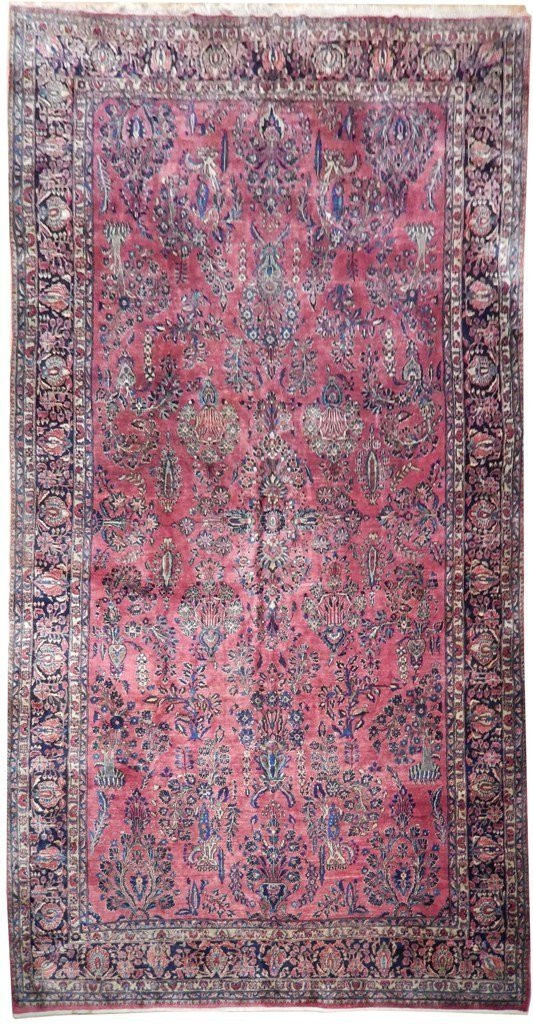
10'2" x 19' Persian Sarouk Rug | Semi-Antique Oversize | All-Over Floral Sprays in Sarouk Red
At 10'2" x 19" wide by nineteen feet long, measured exactly 10'2" x 19', this semi-antique Sarouk reaches across rooms that most handmade rugs simply cannot cover, which is why pieces this long stay scarce among oversize Persian rugs. The wool is the plush, faintly glossy stock that made Persian Sarouk rugs the most requested floor covering in American houses a century ago, still standing at a full 3/8" and knotted on a cotton foundation that keeps a rug of this length lying flat and square. It is a decorator's rug and a collector's rug at once: formal enough for a long dining table, soft enough underfoot to live with daily. It ships with a certificate of authenticity from our Freeport gallery.
Please Note About the Photographs:
The full-length overhead photograph was taken under strong studio lighting and reads lighter and pinker than the rug actually is. The close-up images are the accurate reference: the field is a deep rose red with the warmth typical of Sarouk wool. Colors on your screen will also shift with monitor settings.
Design and Motifs
There is no medallion here, and that is the point. The field carries the classic Sarouk arrangement of detached floral sprays: bouquets of rosettes, budding palmettes and slender serrated leaves floating free on open ground, each spray drawn separately and repeated in staggered rows the whole 19' run. Look closely at the field detail and you see 8 petal rosettes outlined in dark navy, cupped blossoms opening on thin curving stems, and small feathered leaf clusters that fill the space between bouquets without crowding it. The main border reverses the scheme, setting large coral and ivory palmettes with scrolling vine against a deep navy ground, framed on both sides by ivory guard stripes of running vine and a narrow reciprocal outer guard. Because the drawing repeats rather than centers, the rug reads well from any direction, an advantage in a long room where furniture breaks up the sightline.
A Field of True Sarouk Red
Sarouk red is its own color, and this rug has it: a deep rose red with a raspberry undertone that turns warmer where the light catches the pile and cooler in the shadows, shifting gently along the length the way naturally dyed wool always does. Against that field the drawing works in two registers of blue, a saturated indigo navy for the outlines and larger blossoms and a clear sky blue for the smaller flowerheads, with ivory and soft cream carrying the vine work and the guard borders. Coral pink and a dusty rose appear inside the border palmettes, and a quiet sage green shows up in the leaves, just enough to keep the red and navy from reading flat. The navy main border is dark enough to frame the field firmly, so the rug anchors a room rather than floating in it.
Sarouk Weaving in Central Persia
Sarouk is a village in the Arak district of central Persia, in the old Sultanabad weaving region, and its looms have turned out heavy, durable, tightly packed rugs for well over a century. The weavers use the Persian knot on a cotton warp and weft, beat the rows down hard, and leave the pile a touch longer than most workshop cities do, which is what gives a Sarouk its dense, cushioned handle and its long service life. Weaving a piece 19' long takes a wide loom, a big team and years of steady work, so long Sarouks were always the higher end of the village's output. The back of this one shows even, regular knotting throughout and an original end finish, both useful signs when you are working out how to date an Oriental rug, and both consistent with a semi-antique piece that has been carefully kept.


