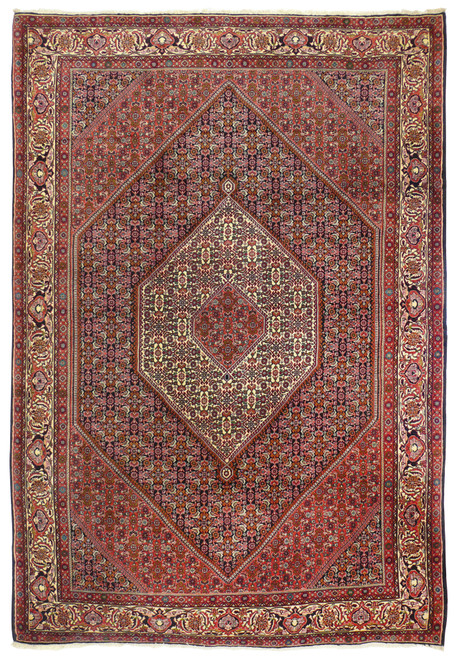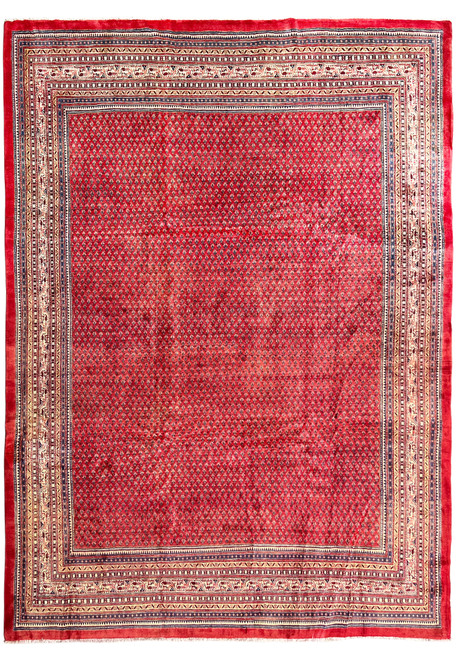

10'2" x 12'8" Persian Kashmar Rug | All-Over Boteh Paisley | Navy Field, Coral Red Border
The boteh is the oldest motif in Persian weaving, the curled teardrop the West renamed paisley, and this 10'2" x 12'8" Kashmar uses nothing else: row after row of large boteh marching across a midnight navy field, each one a little different from its neighbor, inside a coral red border filled with still more boteh. Like all all-over Persian rugs it has no center and no top or bottom, which is exactly why it works in a big room, since it reads the same from every chair. The rug is hand-knotted in wool at 180 to 200 knots per square inch on a cotton foundation, it has never been on a floor, and the selvages are bound in leather on the back to protect the edges. A certificate of authenticity from Rugs.net accompanies the rug.
Design and Motifs
The field is laid out in staggered rows, 7 large boteh to a row, each one about the size of a hand and drawn with a camel outline, a red serrated edge and a filled body of small flowers, leaves and a wine red core, its curled tip hooking to the right. Between the big boteh sit smaller ones in ivory and blue, some with a green cartouche, a few pointing the other way, and the navy ground between them is sown with tiny stems, 4-petal blossoms and sprigs in gold and rust so no patch of plain blue is wider than a finger. An ivory guard border with a navy vine and a second narrow gray green guard with red rosettes separate the field from the main border. That border is coral red and carries its own boteh, alternating between a large upright one with a green heart and blue flame outline and pairs of small hooked boteh in navy, gold and ivory, with clusters of tiny blue daisies scattered across the red between them. A final ivory and navy guard with a leaf scroll and a wide plain navy outer edge finish the rug.
Colors of This Navy and Coral Kashmar Rug
The field is a midnight navy that reads nearly black in flat light and opens up to a deep marine blue where the pile catches the sun, and the plain outer edge repeats the same navy as a solid frame. The main border is a coral red, warmer and more orange than a Kashan red, and it is the color that gives the rug its warmth and its contrast; seen across a room the rug is navy and coral before anything else. The boteh themselves are worked in camel and sand, a warm ivory, a gray green that reads almost like sage, a mustard gold, a burgundy and a brighter wine red in the cores, with sky blue and rust orange in the small flowers. The 2 ivory guard borders act as bright lines that keep field and border apart. On the back the colors sit in a lighter key with no bleeding, and the knot rows are close and regular.
Kashmar Weaving and the Boteh
Kashmar is a weaving town in Khorasan in the northeast of Persia, south of Mashad, and its workshops are best known for large room-size rugs on cotton foundations with heavy, durable wool pile. Most Kashmars are pictorial or medallion pieces; an all-over boteh Kashmar in this size is less common, and it borrows a layout more often seen in the older Mir and Sarough tradition of central Persia. The boteh itself goes back to Safavid textiles and has been read as a cypress bending in the wind, a flame, a seed and a teardrop, which is part of why it has never gone out of fashion. At 180 to 200 knots per square inch the drawing is crisp enough to give each boteh its own filling while the pile stays thick enough for decades of daily use. Among 10x13 Persian rugs it is a piece for a living room, dining room or library where a navy ground and an all-over pattern will hide traffic and hold up under furniture without a medallion to work around.