
| Exact Size in ft: | Width: 9'10' x Length: 13' |
| Size in Inch: | Width: 118" x Length: 156" |
| Size in meters: | Length: 3.96m x Width: 3.00m |
| Some of many colors: | Deep red, garnet, gold, ivory, navy, sky blue, salmon, soft pink, emerald green |
| Shape: | Rectangular |
| Woven: | 100% Hand-knotted | Handmade |
| Foundation: | 100% Cotton |
| Pile: | 100% Wool |
| KPSI: | 220 to 240 |
| Origin: | Persian Mashad | Made in Persia |
| Signature: | Signed Shash-Kalani in the upper main border |
| Age: | Approximately 60 years |
| Condition: | Excellent | Never used |
10 x 13 Persian Mashad Rug, Signed Shash-Kalani, Deep Red Field with Allover Floral and Gold Palmette Border, 220 to 240 KPSI Wool on Cotton
A genuinely rare 10 by 13 Persian Mashad in mint never-used condition at approximately 60 years of age, woven in 100% wool on a 100% cotton foundation at 220 to 240 KPSI, and most importantly signed Shash-Kalani in the upper main border. For the broader context on Mashad weaving, see our complete Persian Mashad rugs guide.
Design and Motifs
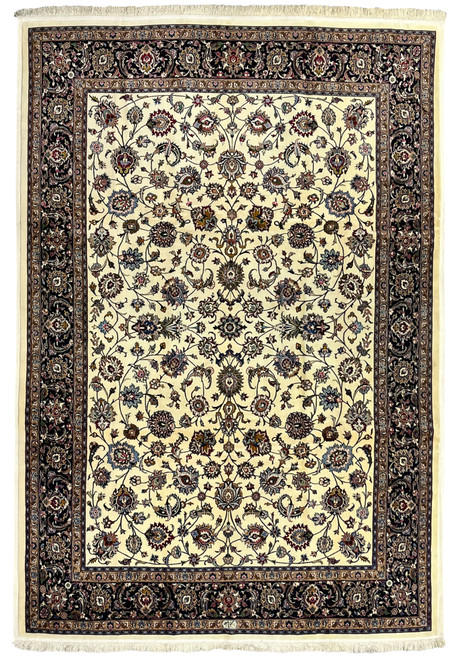
The composition is allover floral and intentionally unmedallioned, allowing the field drawing to carry the entire visual weight of the rug. A deep red ground supports continuous scrolling vinework, large palmettes, and the long curving serrated saz leaves that are a hallmark of Khorasan workshop drawing, interleaved with floral bouquets, rosettes, and small repeating sprigs. At 220 to 240 KPSI the drawing is exceptionally crisp, every curling leaf and every rosette is rendered with clean outlines, and the slight directional rhythm running top to bottom gives the field movement without breaking into a strict repeat. The main border sits on a warm gold and ivory ground and carries the classic Mashad palmette-and-serrated-leaf repeat in red, navy, and salmon, framed on both sides by navy guard borders running delicate floral chain repeats. Centered in the upper main border is the cartouche carrying the Shash-Kalani signature in Persian script, woven directly into the rug as a permanent mark of the workshop.
Colors and Placement
The palette is the rich, slightly cool Mashad red, deeper and more garnet than a Kashan red, set against a warm gold and ivory border that opens the rug up visually and prevents it from reading as overly heavy. Through the field, ivory, navy, sky blue, salmon, soft pink, and emerald green run through the palmettes and bouquets as accents, and the gold of the main border picks up the small gold florets scattered throughout the field. The pile is full and the colors are completely fresh because the rug has spent sixty years rolled in storage rather than under furniture. At a true 10 by 13 this is a comfortable formal room size, working under a 10 to 12 seat dining table with chairs pulled back, anchoring a large living room with the front legs of all major furniture on the rug, filling a primary bedroom centered around the bed, working end to end in a long library or great room, or laying as a statement floor in a formal foyer, executive office, or lobby. The Mashad red and gold combination is the foundation palette of formal traditional, English manor, Georgian, federal, and old-world transitional interiors.
Origin and Construction
Mashad, the capital of Khorasan province in northeast Iran, is a region long associated with refined wool, deep saturated dyes, and workshop weaving of the very highest commercial grade. Within Mashad weaving, the Shash-Kalani name occupies its own tier. The Shash-Kalani master established a private atelier dedicated to producing rugs of consistently exceptional quality, and ran his looms with rigorous oversight of every stage of the process, from wool selection and dyeing through to spinning, weaving, washing, and finishing. Each piece that left the workshop carried the Shash-Kalani signature woven directly into the border as a guarantee of that standard. International collectors and serious buyers learned early that a Shash-Kalani signed Mashad was a different category of acquisition from a generic Mashad, both for the weave quality and for the long-term value, and pieces in the original mint condition like this one have become genuinely difficult to source at any price. This particular example is fully hand-knotted in 100% wool on a 100% cotton foundation at 220 to 240 KPSI, sixty years old, never used, with the pile full and the colors fresh and saturated.