
| Size in ft: | Width: 12' x Length: 17'7" |
| Size in Inch: | Width: 144" x Length: 211" |
| Size in meters: | Length: 5.36 x Width: 3.66 m |
| Colors: | Ivory, Red, Navy Blue, Light Blue, Gold, Olive Green, Salmon, Brown |
| Shape: | |
| Woven: | 100% Hand-knotted | Handmade |
| Foundation: | |
| Pile: | |
| KPSI: | |
| Age: | 1970s | Approx. 50 Years |
| Design: | All-Over Floral | Strapwork Cartouches | No Central Medallion |
| Origin: | |
| Condition: | Excellent | Never used |
12 x 17'7 Persian Isfahan Rug | Ivory All-Over Floral Field | 1970s | Approx. 400 KPSI
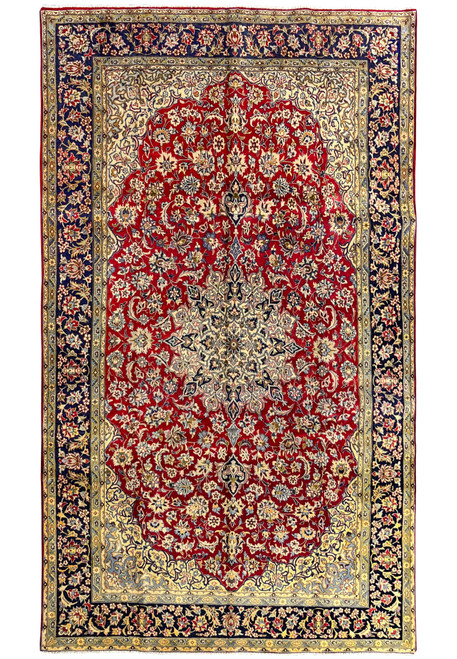
Woven in the 1970s, under the last years of the kingdom, and it still carries that taste: confident, formal, no shortcuts. This Persian Isfahan measures 12' x 17'7", hand-knotted in wool with silk highlights on a cotton foundation at roughly 400 knots per square inch. It has never been on a floor and it does not look 50 years old, it looks like it came off the loom this year. What sets it apart from most Isfahans is the layout. There is no central medallion. The whole field is one continuous all-over composition, which is harder to design and far harder to keep balanced across a rug this long. If you are shopping at this scale, the rest of our oversize 12x18 Persian rugs are worth seeing alongside it. A certificate of authenticity comes with it.
Design and Motifs
The ivory field is covered corner to corner in a symmetrical all-over floral, built on thin brown and red vines that split, curl and rejoin without ever crossing themselves. Hung on those vines are large navy palmettes with red and gold hearts, fan shaped lotus blossoms in red and light blue, serrated saz leaves, small 5 petal flowerheads and cypress tipped bud clusters. Running through all of it is the feature that gives this rug its character: a bold red and navy strapwork band that loops down the length of the field and ties itself into interlocking diamond knots, each knot pinned with a small gold and blue cartouche. That strapwork is what the eye follows, and it turns a repeating pattern into a composition with movement. The border system runs seven bands. The wide main border is deep red, carrying navy palmette cartouches alternating with cream and blue floral sprays. On either side sit ivory guard bands of small repeating blossoms, then narrow navy meander stripes at the inner and outer edges. Look at where the border turns at each corner: the pattern resolves cleanly on all four, which on a rug this long is the real test of the cartoon and the weaver following it.
Colors in Detail
The field is a warm ivory, closer to unbleached cream than white, with a faint straw tone that keeps it from looking cold, and across 17 feet it holds absolutely even with no banding. The main border is a deep tomato red with real depth to it, warm rather than blue, and it frames the pale field without shouting. The darkest note is the navy, nearly black in the palmettes and the guard meanders, and it is what gives the drawing its edge against the ivory. Between those three the secondary colors carry the detail: a clear light blue that appears in almost every blossom and reads as the second color of the rug, a mid cornflower in the larger flowerheads, a muted gold to old brass in the palmette centers and the strapwork cartouches, olive and moss green through the leaves and stems, soft salmon in the smaller petals, and a warm walnut brown in the vinework itself. Then the silk. It is not a silk rug, it is wool with silk worked into selected blossoms and vine outlines, and you notice it as a change in the light rather than a change in material. Walk the length of this rug and parts of the pattern lift and go quiet again as the silk catches you.
Origin and Weaving
Isfahan sits in central Persia and has been the country's benchmark for fine weaving since the Safavid court built its workshops there in the 16th century. The city's reputation rests on drawing: curved line, flowing vine, floral detail rendered with a precision the rest of the country approximates and rarely matches, and that only works if the knot count is high enough to carry it. At roughly 400 knots per square inch on a cotton foundation, this rug has the density to hold every palmette and every hair thin vine in shape across the full length, and the weight to lie flat from the day you unroll it. The 1970s were the last great commercial period for Isfahan before the market changed, and rugs from those years, woven for a domestic clientele who knew exactly what they were looking at, are the ones collectors chase now. Turn this one over and the back is as crisp as the front. Never used, full pile, straight sides, clean fringe.