
| Exact Size in ft | Width: 8'4" x Length: 14' |
| Size in Inch | Width: 100" x Length: 168" |
| Size in meters | Length: 4.35m x Width: 2.57m |
| Some of many colors | Deep Red, Ruby, Ivory, Cream, Navy Blue, Indigo, Sky Blue, Gold, Olive Green, Burgundy |
| Woven | 100% Hand-knotted | Handmade |
| Foundation | Cotton |
| Pile | 100% Wool |
| Shape | Rectangular |
| Style | Traditional, Classic Persian, Floral Medallion, Allover Floral |
| Origin | Persian Isfahan | Made in Persia |
| Age | Approximately 30 to 40 years |
| KPSI | 220-240 KPSI |
| Condition | Excellent | Never Used |
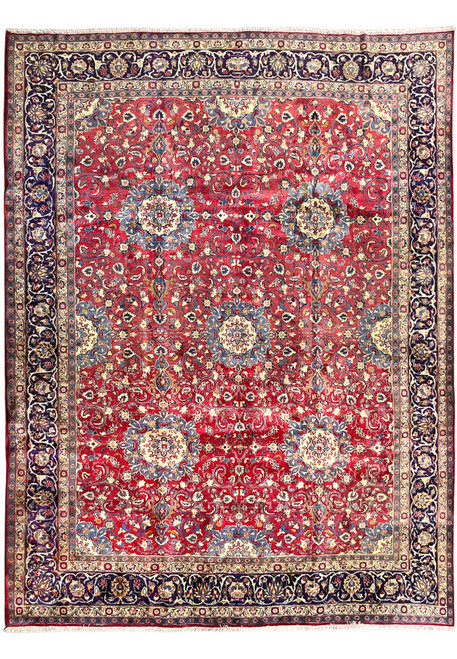
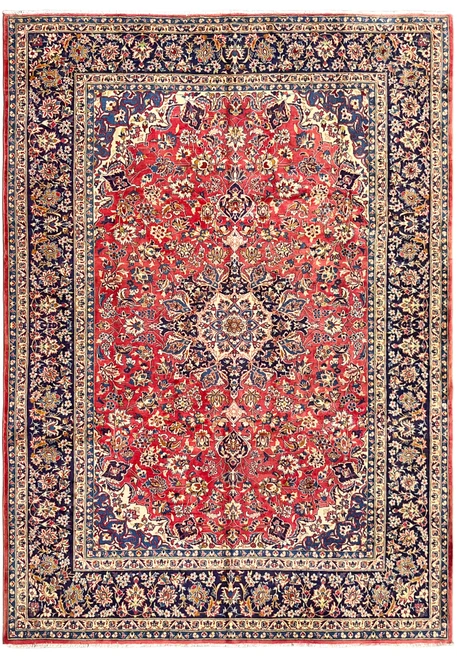
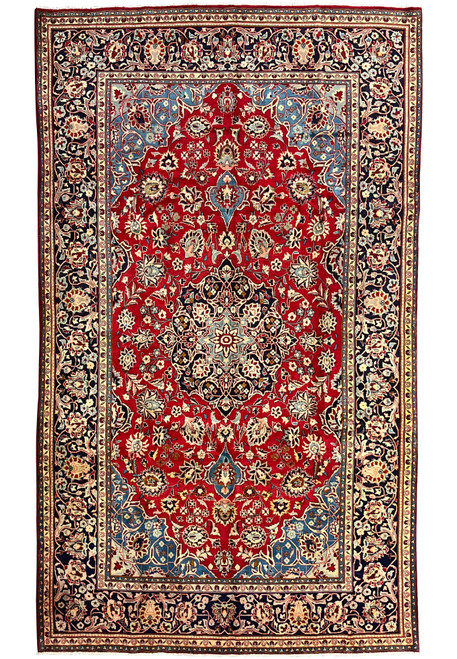
8'4" x 14' Persian Isfahan with Ivory Floral Medallion on a Deep Red Field
This 8'4" x 14' Persian Isfahan is the kind of piece that comes along rarely, both because of its unusual gallery size and because it has been kept in never-used condition for the thirty to forty years since it left the loom. The deep red field carries a serene ivory floral medallion at center with matching corner spandrels, framed by a navy main border alive with palmettes and curling vines. Everything about it, from the drawing to the color balance to the finish, points to a fine workshop piece in the classic Isfahan tradition. For deeper context on what makes Isfahan rugs distinct, our complete guide to Isfahan rugs walks through the design language, the workshops, and what separates a true Isfahan from rugs that imitate the style.
Design and Motifs
The composition follows the classical Isfahan medallion-and-corners format. A large ivory medallion sits at the center of the field, drawn as a layered floral rosette with two slender pendants extending vertically along the rug's long axis. Ivory corner spandrels mirror a quarter of the medallion at each corner, giving the eye a clear and balanced anchoring at every point of the rug. The red field between is densely filled with a Shah Abbasi vocabulary of palmettes, saz leaves, lotus blossoms, and curling vine scrolls, all rendered with the precise curvilinear drawing that defines Isfahan workshop weaving. The navy main border carries a stately procession of larger palmettes connected by floral scrolls, framed by sky-blue and gold guard borders that step the design down cleanly to the edge. Nothing here is improvised. Every motif sits exactly where the design demands.
Colors and Placement
The palette is built around a deep, true Persian red that has the warmth of madder root rather than anything modern or synthetic-looking, paired with a soft ivory medallion and a deep navy main border. Sky blue, gold, olive green, burgundy, and small flashes of cream and pale rose work through the field to give the design dimension without ever pulling focus from the central medallion. The 8'4" x 14' size is genuinely rare, longer and narrower than the standard 9 by 12, which makes it ideally suited to long dining rooms, gallery hallways, libraries, and large foyers where a standard size sits awkwardly. It pairs naturally with traditional and transitional interiors, walnut and cherry furniture, leather seating, and rooms where you want one piece of serious craftsmanship to set the tone for everything else.
Persian Isfahan Rugs and Construction
Isfahan is the historic capital of central Iran and one of the most important cities in the entire history of Persian art. Under Shah Abbas in the late 16th and early 17th centuries, Isfahan became the cultural heart of the Safavid empire, and the rug workshops established there set the template that the rest of the Persian rug world has followed ever since. Isfahan weavers are known above all for the precision of their drawing, the elegance of their medallion designs, and the discipline of their color palettes. A true Isfahan reads as composed and architectural rather than busy. This rug is hand-knotted on a cotton foundation with a 100% wool pile at 220 to 240 KPSI, placing it firmly in the fine workshop quality range. The fact that it has never been put down for use in the three to four decades since it was woven means the pile is full, the colors have not faded, and the structure is exactly as it left the loom. For a deeper look at the materials that go into rugs at this level, including foundations, kork wool, and how knot density relates to design clarity, see our complete guide to handmade rug materials.