
| Exact Size in ft: | Width: 7'5" x Length: 12'7" |
| Size in Inch: | Width: 89" x Length: 151" |
| Size in meters: | Length: 3.84m x Width: 2.34m |
| Some of many colors: | Rose Red, Navy, French Blue, Sky Blue, Ivory, Gold, Sage, Salmon, Brown |
| Shape: | Rectangular |
| Woven: | 100% Hand-knotted | Handmade |
| Foundation: | 100% Cotton |
| Pile: | 100% Wool |
| KPSI: | 200 - 220 |
| Origin: | Persian Najafabad | Made in Persia |
| Condition: | Excellent | Never used |
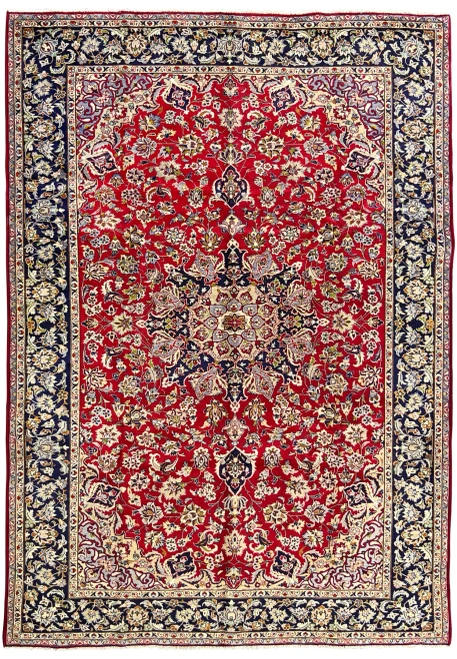
8x13 Persian Najafabad Rug | Rose Red Field Navy Border | Layered Medallion | 200-220 KPSI
An 7'5" x 12'7" hand-knotted Persian Najafabad rug woven in the Isfahan tradition, with a rose red field, French blue corner spandrels, a deep navy main border, and a layered diamond medallion at center. Najafabad sits just west of Isfahan and shares its weaving DNA, the same Shah Abbasi palmette vocabulary, the same fine drawing, the same kork wool pile on cotton foundation, produced in larger formats and slightly more forgiving prices than city Isfahan itself. This piece is approximately forty years old, in mint unused condition, and woven at 200 to 220 knots per square inch, the upper quality range that Najafabad workshops are known for. The complete guide to Isfahan rugs covers the broader Isfahan school this Najafabad belongs to.
Design and Motifs
The center holds a layered diamond medallion with a navy core, an eight-point starburst rosette at its heart, and ivory cusped lobes radiating outward in two tiers of floral pendants. Pendant cartouches drop above and below into the field, drawing the eye through the long axis of the rug. The rose red field is filled with a dense vocabulary of Shah Abbasi palmettes, sunburst rosettes, curling vines, and small bird motifs, all drawn with the precise, almost architectural symmetry that distinguishes the Isfahan school from looser tribal weaving. The four corner spandrels switch to French blue, lighter and softer than the navy border, and carry the same palmette and vine work in inverted color. The main border alternates blossoming palmettes against deep navy, framed by ivory minor borders of vine and rosette.
Colors and Placement
The palette is what makes a good Najafabad recognizable across a room. The rose red is true red with a slight cool lean, neither orange nor purple, and it holds against both warm and cool wood tones equally well. The French blue spandrels are the giveaway detail — Najafabad weavers favor that brighter, softer cornflower blue at the corners where Kashan and Mashad workshops would use deeper navy or burgundy. Ivory, gold, sage, and salmon accents thread through the floral work and keep the field from feeling heavy. At 7'5" x 12'7" this rug is sized for a formal dining table seating eight to ten with chairs fully drawn back, or as the anchor of a long living room with sofa, two chairs, and a coffee table sitting on the field with the medallion centered between them.
Origin and Construction
Najafabad is a town roughly twenty miles west of Isfahan in central Iran. Weavers there work in the Isfahan tradition but specialize in larger rugs and carpets that fall outside what the smaller Isfahan city workshops typically loom. This rug is hand-knotted in 100% kork wool pile on a cotton foundation at 200 to 220 knots per square inch, which puts it at the top of standard Najafabad quality. Despite being approximately forty years old, it has never been on a floor and arrives in the exact condition it left the loom, full pile, intact selvages, clean fringe, and saturated original color. For more on how the Isfahan school compares to other Persian wool weaving cities, our guide to the world of Persian rugs is a good starting point.