
13'5" x 23'5" Antique Persian Mashad Amoghli Rug | Signed Oversize Palace Size | ca. 1900-1920
Most palace size rugs are bought to fill a room. This one is acquired the way a painting is. Woven in the Amoghli workshop between roughly 1900 and 1920 and signed in its outer border, this 13'5" x 23'5" Persian Mashad rug comes from the one Khorasan workshop whose name carries real weight in the auction rooms, and it looks the part: an entire field built as a single radiating medallion in lapis, ivory, raspberry, saffron gold and sky blue. The pile is hand-knotted wool on a cotton foundation, with the drawing still crisp from the center rosette to the last guard stripe. Both ends finish in white cotton fringe, and the side edges are overcast in cream wool. After more than a century the rug remains in excellent condition. A certificate of authenticity from Rugs.net accompanies the rug.
Design and Motifs
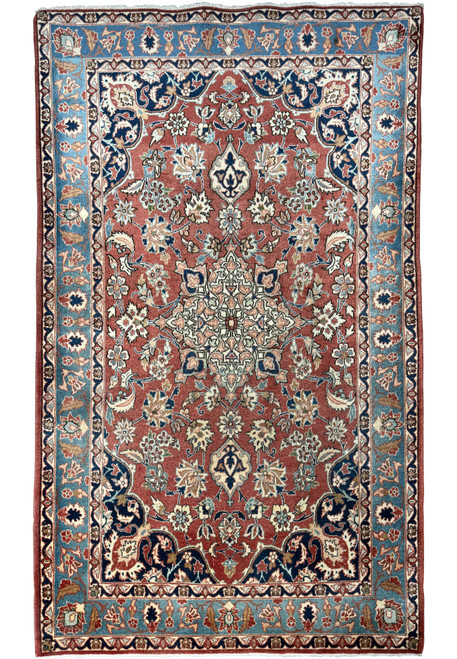
Start at the center and the logic of the whole rug unfolds. A small floral rosette sits at the heart of a lapis ground, and 4 crimson lozenge pendants, each outlined in ivory and filled with blossoms, point out to the cardinal directions like the hands of a compass. Around them the lapis core is packed with a dense lattice of tiny flowers, palmettes and scrolling tendrils, and its outline is not a smooth frame but a serrated, leaf-edged star. From there the design refuses to stop. Ring after ring of the same flame-like leaf edge pushes outward: first a wide ivory halo trailing flowering vines and small coral palmettes, then broad raspberry leaves overlapping midnight navy, then a band of saffron gold, then sky blue and crimson, until the outermost ring reaches the border itself and floods the 4 corners in navy, crimson and sky blue. There is no plain field and no conventional corner spandrel, which is exactly what makes this layout so rare; every ring carries its own vines, blossoms and curling tendrils, so the rug reads from across a room and still rewards a close look. The border answers all that motion with order. An ivory inner guard of meandering floral vine, set between narrow striped bands, opens onto a wide wine red main border where sky blue cloud band cartouches frame floral rosettes in a steady procession, and beyond it runs an outer navy band of ivory arabesques and blossoms. The Amoghli signature is woven in ivory knots inside a small navy arch of that outer band, followed by a thin red guard of tiny flowers, cream overcast side edges and white cotton fringe at both ends.
Colors of This Lapis Blue Mashad Rug
The palette is the reason collectors stop scrolling. The central ground is a true lapis blue, deeper and more saturated than navy, with the stony glow of polished lapis lazuli, and it sits against a warm ivory halo that reads almost cream in the close-up shots. Next comes the rug's boldest color, a raspberry pink with a violet undertone that tips toward magenta in raking light and softens to rose when viewed with the nap. Midnight navy leaves cut through the raspberry, then the saffron band arrives: a warm, slightly mustard gold that brightens the whole composition and keeps the blues from ever feeling heavy. The sky blue ring shows the gentle abrash of wool dyed in small batches, shifting from powder blue to a greener turquoise across its width, and it meets a clear crimson that is redder and brighter than the border. Within every ground the small drawing is picked out in coral, peach, soft pink, ivory, tan, brick, moss green and teal, which is why the field reads as a jewel box rather than a simple scheme. The main border is a darker wine red, closer to claret than to crimson, carrying sky blue cartouches and ivory guards, a more classical tone that frames the field without competing with it. Walk around the rug and the colors move with the pile: looking into the nap the blues deepen and the raspberry leans toward plum, looking with it everything lightens and the saffron nearly glows. The back mirrors the front clearly, with the design readable knot for knot in softer, dustier versions of the same colors.
The Amoghli Workshop and the Court Rugs of Mashad
Mashad, the shrine city of Khorasan in northeastern Persia, has woven rugs for centuries, yet most of its output was sturdy commercial work sold by the square meter. In the decades around 1900 a small group of city workshops lifted that tradition to a court level of refinement, and the Amoghli atelier stood at the top of the group. It was run by 2 brothers, Abdol Mohammad and Ali Khan Amoghli, grew into one of the largest and most admired rug workshops of its time, and produced most of its celebrated pieces between about 1900 and 1920. The brothers worked with the finest wool they could obtain, used silk and cotton where a commission called for it, and had the Amoghli name woven into their rugs as a mark of authorship. That standard carried them to the royal household: under Reza Shah, Amoghli rugs were chosen for the Pahlavi court and furnished the Sa'dabad palace complex in northern Tehran. Mashad has no Raj or La grading scale, so a rug like this is judged by its maker, and the difference from ordinary Mashad production is visible in every section: a denser and more disciplined knot, drawing that holds its curves at every scale, and a willingness to reinvent the classical medallion instead of repeating it. Signed Amoghli pieces of true palace dimensions rarely surface in this condition, and among the oversize Persian rugs we have handled, this 13'5" x 23'5" example, with its radiating rings of lapis, raspberry and saffron gold, shows the workshop at the height of its ambition.