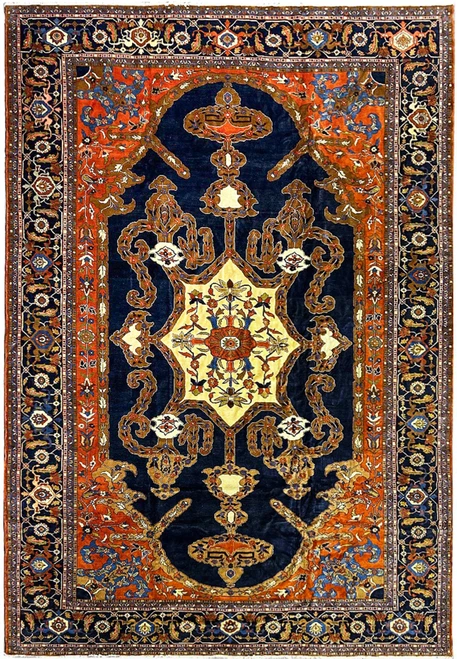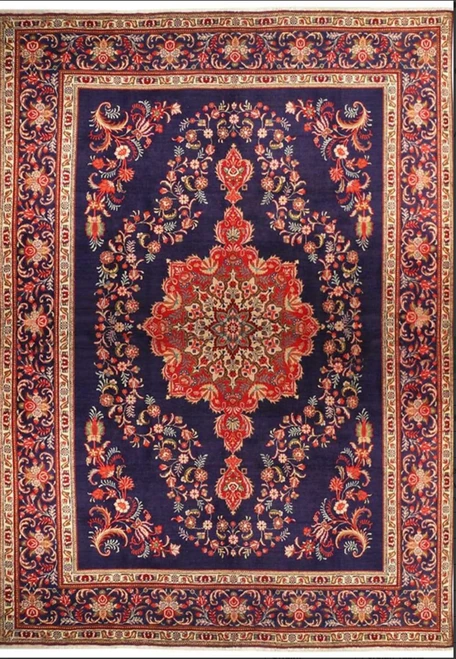

13'1" x 19'8" Persian Tabriz Rug | Master Emad Zarine | Apricot Field Three Medallions | Oversize Palace Size | Circa 1960
Some rugs come along once in a dealer's career, and this is one of them. It is a 13'1" x 19'8" Persian Tabriz from the workshop of Master Emad, hand-knotted in the late 1950s or early 1960s and never used since. Three medallions float down an apricot field, one in rust red at the center and two in deep turquoise at either end, surrounded by burgundy cartouches, green quatrefoils and ochre corner pieces, all inside a wide rust red border. It is woven in fine wool on a cotton foundation at roughly 500 knots per square inch, with a full, dense pile that has never seen a footstep. More than 60 years after it left the loom, the colors are as clean as the day it was cut free. It is truly one of a kind, and it comes with our certificate of authenticity.
Design and Motifs
The central medallion is a scalloped rust red rosette edged in navy, filled with ivory arabesque scrolls and small rosettes. At its heart, a turquoise star ring with gold blossoms opens into an ivory flower, and chartreuse palmettes point outward from its rim. The 2 end medallions repeat the form in turquoise, so the eye travels the full 19'8" length in a steady rhythm of blue, red and blue. Between them sit smaller quatrefoil medallions in turquoise and mint, each holding 4 lotus palmettes around a red rosette, while dark forest green quatrefoils are scattered across the field like inlaid tiles. Along both sides, deep burgundy lobed cartouches frame the composition, and the 4 corners are filled with ochre quarter medallions. The rest of the apricot ground is covered in a fine web of vines carrying palmettes, pomegranate buds, curling leaves and small blossoms in red, blue, green and gold. The main border is rust red, laced with ivory arabesque strapwork that links turquoise rosettes and large chartreuse and teal palmettes. It is framed by forest green guard stripes with gold vine scrolls and a mint outer guard of small rosettes, finished with a narrow apricot band of tiny stepped motifs.
The Colors: Apricot, Rust Red and Turquoise
The field is a warm apricot, somewhere between peach and soft salmon. It is light enough to brighten a very large room, yet rich enough to hold its own against the strong colors laid on top of it. Rust red, close to terracotta, fills the central medallion and the main border and gives the rug its warmth from across the room. Turquoise is the boldest note, a deep, saturated blue-green in the 2 end medallions and many of the palmettes, cooled further by mint in the quatrefoils and the outer guard. Forest green frames the border and anchors the scattered quatrefoils. Burgundy deepens the side cartouches, ochre and gold warm the corners, and ivory, navy, rose pink and chartreuse carry the fine drawing throughout. None of these colors fights the others. They sit together in a balance that feels calm despite how many there are, and that balance is exactly what sets a master's palette apart. The fringe is natural cotton.
Master Emad and the Tabriz Workshops
Tabriz, in northwest Persia, has produced some of the most accomplished workshop rugs in the country for centuries, and the city's leading masters each developed a style that collectors can name at a glance. With Master Emad, it is the color. He worked closely with his dyers to fix his own shades and used them again and again, so that a trained eye recognizes one of his rugs across a room, without needing to find a woven name. The apricot ground, the turquoise and the clear rust red in this piece are characteristic of his hand. Pieces from his workshop that survive in never-used condition are very scarce, and at this size they are rarer still. Among oversize Persian rugs, a master-attributed Tabriz from around 1960 that has never been laid down is a genuine collector's find. Like other palace-size Persian rugs, it is made for a great room, a formal living room or a grand dining hall, and it was woven to last for generations.