| Size in ft: | Width: 2'7" x Length: 10'1" |
| Size in Inch: | Width: 31" x Length: 121" |
| Size in meters: | Length: 3.08 x Width: 0.80 m |
| Colors: | red, orange, navy, ivory, pink, saffron |
| Shape: | |
| Woven: | 100% Hand-knotted | Handmade |
| Foundation: | |
| Pile: | |
| KPSI: | |
| Signature: | "Qum Mohammad Labbafan" | Workshop piece |
| Origin: |
Persian Qom | Made in Persia |
| Condition: | Excellent | never used |
2'7" x 10'1" Persian Qum Silk Runner Rug | Signed Mohammad Labbafan | 70 Raj, Approx. 645 KPSI
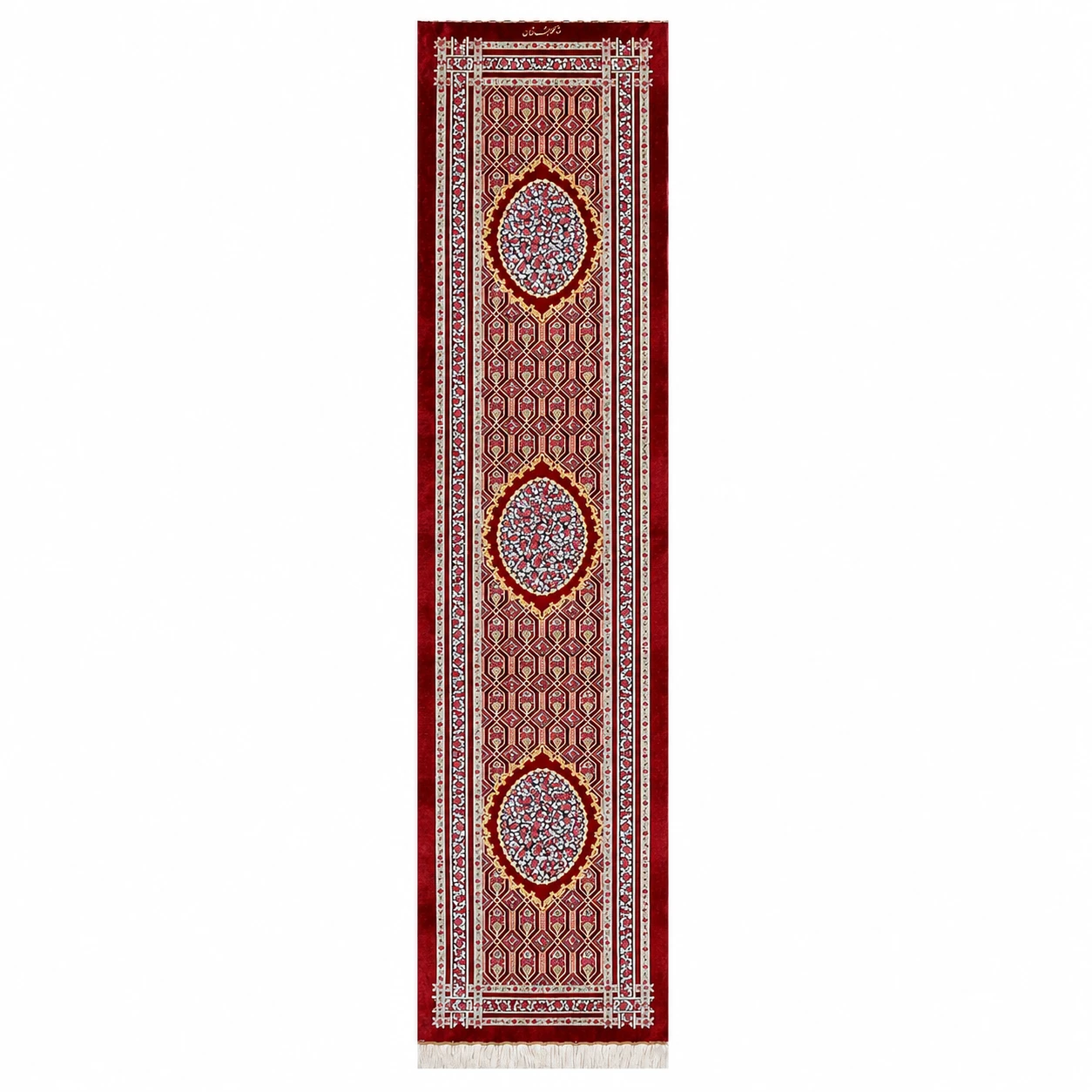
This is a silk on silk runner of the kind Qum workshops weave to show what they can do. The pile is 100% pure silk, the warps are silk as well, and the weave runs at 70 Raj, roughly 645 knots per square inch, which is why the drawing holds crisp rose heads barely a quarter inch across. At 2'7" x 10'1" it reads as a long, narrow jewel rather than a floor covering, light enough to hang and fine enough to study from a foot away. The cartouche at the top end carries the woven signature of the Mohammad Labbafan workshop, so this is a named piece rather than an anonymous one, and it is in excellent condition with full, even pile and tidy silk fringe. A Persian silk rug of this grade ships with our certificate of authenticity recording origin, materials, knot count and signature.
Design and Motifs
Three oval medallions sit along the length, each one a navy ground packed solid with pink and ivory roses and ringed by a saffron scrolling vine that breaks into little leaf tips. Between and around them runs a lattice of elongated hexagons, outlined in thin ivory lines, every compartment holding either a rose spray or a small gold vase with flowers rising out of it. The field behind all of this is open red silk, left plain at the outer edges so the pattern reads as a panel floating on a solid ground. The borders stack up in narrow bands: a navy rose vine as the main guard, flanked by pale green stems, pearl rows and a thin saffron line, with ribbon crossings framing a rectangular panel at each end in the way fine Qum drafts often finish a long format. Among Persian runner rugs this amount of detail per square foot is unusual, since most runners are drawn simply and repeated.
Color and the Behavior of the Silk
The dominant color is a deep tomato red that warms toward orange where the light hits the nap straight on and drops to a dark wine tone when viewed against the pile. Silk takes dye deeper than wool and reflects light instead of absorbing it, so the same runner looks bright from one end of a hall and dark from the other, and the plain red margins show this shift most clearly. Against that field the medallion grounds are a true navy, almost black at the edges of the ovals, which throws the salmon pink and ivory rose heads forward. The saffron yellow vine work is the only strong contrasting color and it does a lot of work, separating navy from red everywhere the two meet. Soft sea green appears in the minor guard stripes, pale sky blue in the rose foliage, and ivory in the lattice lines and pearl rows. The end fringe is a blush silk, tonal with the field rather than white.
Qum Origin and Weaving Quality
Qum sits in central Persia and is the youngest of the great weaving cities, which is exactly why it became the silk capital: with no long village tradition to defend, its workshops competed on fineness alone, and the best of them use only top grade silk. That rivalry is the reason Qum silk rugs are measured in Raj rather than in rough knot ranges, and at 70 Raj this piece sits near the top of what any workshop attempts; the signature "Qum Mohammad Labbafan" in the upper cartouche is the atelier putting its name on that claim. Weaving a silk warp instead of cotton makes the loom harder to keep square and the finished rug lighter and more supple, and you can feel that here, along with the slight translucence silk warps give the back. Expect the pile to be short and firm, the knots visible as tiny even rows on the reverse, and the rug to lie flat without the weight a wool runner of this length would carry.