
| Size in ft: | Width: 3'3" x Length: 5'3" |
| Size in Inch: | Width: 39" x Length: 63" |
| Size in meters: | Length: 1.61 x Width: 1.00 m |
| Colors: | Ivory, Sand, Navy, Salmon Pink, Rust, Burgundy, Magenta, Sage Green, Teal, Sky Blue, Gold, Lavender |
| Shape: | |
| Woven: | 100% Hand-knotted | Handmade |
| Foundation: | |
| Pile: | |
| KPSI: | |
| Age: | Approx. 40 years | Semi-antique |
| Design: | Paradise | Pictorial Garden | Tree of Life with Animals and Birds |
| Origin: |
Persian Tabriz | Made in Persia |
| Condition: | Excellent | Never used |
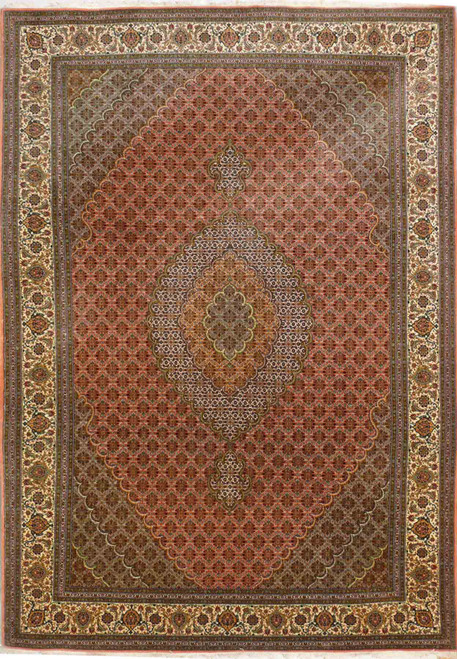
3'3" x 5'3" Persian Tabriz Paradise Rug | Pictorial Kork Wool & Silk, Ivory Garden of Animals | 50 Raj, 400 KPSI, Never Used
This 3'3" x 5'3" Persian Tabriz is what the trade calls a Paradise rug: not a pattern but a picture, a whole garden of trees, flowers, birds and animals drawn on an ivory ground with the same care a miniature painter would give a manuscript page. It was woven about 40 years ago at 50 Raj, roughly 400 knots per square inch, in kork wool with silk highlights on a cotton foundation, and it has never been on a floor. The pile is full and springy across the whole piece, the white fringes are clean and intact, and the colors are as bright as the day it came off the loom. The back still carries an old European dealer note confirming 50 Raj, kork wool with silk on cotton. A certificate of authenticity from Rugs.net accompanies the rug.
Design and Motifs
Read the field from the bottom up like a landscape. Two trees rise from the lower edge: a sage-green leafy tree at the center with a broad, spreading crown, and beside it a rust and burgundy flowering tree whose branches carry a long-tailed pheasant. A third tree climbs the left side in sky-blue and brown, hung with clusters of blue, gold and pink blossoms, and halfway up it holds a woven bird's nest with 2 chicks inside. Around the trees the animals go about their business: in the lower left a spotted leopard has caught a deer and pinned it on its back on a gold hillock, the one moment of drama in the whole garden, while a spotted fawn leaps away through teal grasses below. A lavender-gray gazelle bounds across a pale rock at lower right, a pair of tan gazelles stand together on a hillock at mid-right, and an orange-red gazelle leaps at the top left with another resting on a mound at top right. Between them a large blue-gray bird spreads a fanned tail, a crested pale bird stands on a stony rise beside it, and a rose-and-lavender songbird perches on a branch of the left tree. Every gap is filled with tulips, carnations, blossom sprays, thistles and small ground plants, and the whole field is framed by a narrow navy guard on a floral vine. The wide main border is a second garden on a sand-colored ground, divided into landscape panels: leaping deer on hillocks, blue streams running between flowering shrubs, small perched birds, a full rose bouquet at the center of each end, and at each corner a large long-legged crane standing among flowers. A final navy guard with a pink and ivory blossom vine and a plain salmon-pink outer edge close the composition.
Colors of This Ivory Tabriz Paradise Rug
The field is a clean, warm ivory, the color of heavy cream rather than white, and it does the work a white gallery wall does: everything drawn on it reads sharp and separate. The main border sits a step darker on a soft sand beige, so the two grounds stay distinct without competing. Against those two neutrals the palette is unusually wide for a Tabriz. Greens run from a pale sage in the big central tree through olive and a dark bottle green to a bright teal in the grasses and the pheasant's plumage. Reds cover burgundy blossoms, a true tomato red in the pomegranates and carnations of the border, rust orange in the gazelles and the flowering tree, and a hot magenta in the border roses. Blues include a sky blue for the streams and the tree trunk, a mid cornflower blue in small flowers, a lavender periwinkle in the deer and birds, and a deep navy for the guard stripes and the outlines. Gold ochre colors the hillocks, the leopard and the peacock's tail feathers, and a salmon pink runs the length of the outer selvage. In the close-up photos you can see silk picking out the yellow outlines of the pink flowers and the water of the streams, catching the light with a glassy shine the wool around it does not have. The back shows every one of these colors in a lighter key with no bleeding or fading.
Tabriz Paradise Rugs and the Raj System
Tabriz in northwest Persia grades its rugs by Raj, the number of knots across a 7 cm span of the width: 40 Raj is commercial work, 50 Raj is fine, and 60 Raj and above is collector territory. At 50 Raj this rug sits at the point where a weaver can draw a leopard's spots, a bird's eye and a 5-petal blossom without the shapes turning to blocks, which is exactly what a Paradise design demands. The garden-of-paradise theme with animals under flowering trees goes back to the Safavid court carpets of the 16th century, and Tabriz workshops kept it alive in small formats like this one, woven in kork wool, the soft first-shearing fleece from the lamb's neck and shoulders, with silk reserved for the details that should shine. Pieces this size are bought as often for a wall as for a floor, and among 3x5 Persian rugs a pictorial Tabriz that has spent 40 years unused is the kind that is hard to replace once it is gone.