3'8" x 5'8" Persian Isfahan Rug | Wool and Silk on Silk | Ivory Field, Pistachio Spandrels, Sky Blue Border
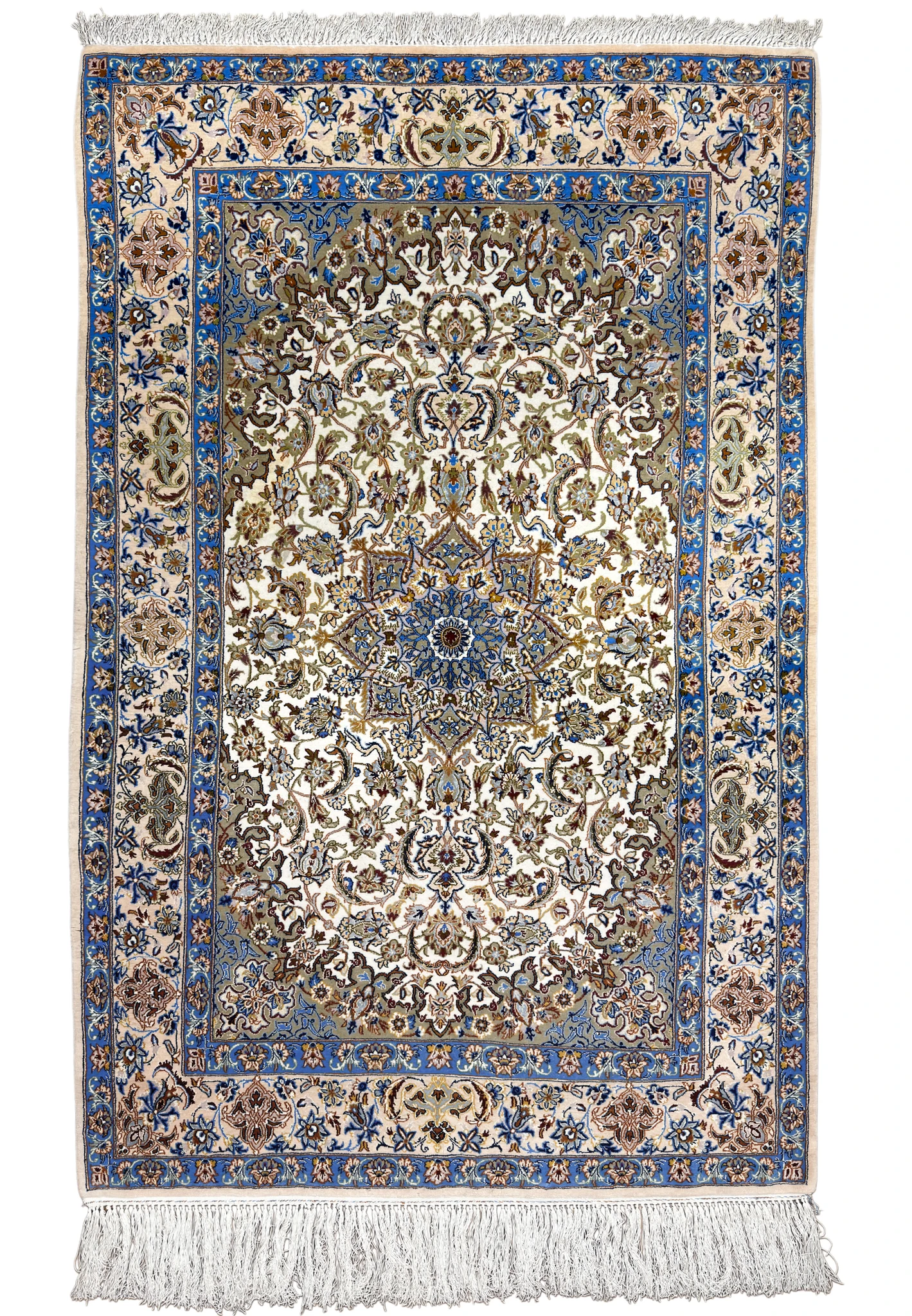
A small Isfahan at 560 to 580 knots per square inch is a rug you buy for the drawing, and this 3'8" x 5'8" piece has the drawing. It is knotted in wool with silk worked through the flowers on a pure silk foundation, so the palmettes on the ivory field carry a shine the wool around them does not, and the vines between them are drawn a single knot wide. The palette is the unusual part: instead of the navy and red most Isfahans lean on, this one pairs an ivory field with pistachio green corner spandrels and a clear sky blue in the guards and outer band, a combination that reads light and cool from across the room. The pile is full and even, the long ivory silk fringes are intact at both ends, the back still carries the old European dealer label, and the rug has never been on a floor. A certificate of authenticity from Rugs.net accompanies the rug.
Design and Motifs
The medallion is an 8-point star built in 3 rings. At the center a small burgundy rosette sits inside a ring of white petals, surrounded by a sky blue disc filled with tiny navy and ivory flowers; around that a pistachio green ring carries 8 pointed lobes edged in lilac gray, each one holding an ivory palmette and a pair of blue tulips; and the outer star is drawn as 8 large ivory and peach points edged in burgundy, with orange and blue blossoms at their tips. The ivory field around the star is filled with an all-over lattice of Shah Abbas palmettes, lotus flowers and serrated saz leaves on olive and chestnut vines, mirrored across both axes so the same bloom appears in each quarter, and a pair of ivory pendant cartouches with burgundy flower cores hang on the vertical axis above and below the medallion. The 4 corners of the field are cut by pistachio green spandrels with a scalloped inner edge, each one filled with a matching palmette-and-vine arabesque in ivory, orange and blue. A sky blue inner guard with an ivory and orange floral vine frames the field, followed by the wide main border on a peach cream ground, which carries large lobed cartouches in chestnut and orange alternating with sprays of blue blossoms on a thin blue vine, and a second sky blue guard with palmettes closes the frame before a plain peach selvage.
Colors of This Ivory and Pistachio Isfahan Rug
The field is a warm ivory, the color of heavy cream, and because the drawing on it is worked in olive, chestnut and soft blues rather than strong colors, the ivory stays the dominant note of the rug. The corner spandrels are a pistachio green, a pale yellow-green with a gray cast that sits between sage and celadon, and the same pistachio returns in the cartouches at the center of each border side. Against those 2 grounds the sky blue of the guards and the outer band is the brightest color on the rug, a clear cornflower blue that frames the whole composition and picks up the powder blue used in the medallion disc and the small flowers. The main border sits on a peach cream, a shade warmer and pinker than the field, so the border reads as its own band without a hard edge. Inside the flowers the palette runs through a burnt orange and a chestnut brown for the large palmettes, burgundy for the rosette cores and outlines, an olive and a moss green in the leaves, a lilac gray in the medallion lobes, and navy for the finest outlines. The silk in the pile is concentrated in the ivory and white flower petals and the blue tulips, which is why those spots flash in the angled photographs while the wool ground stays matte. The back shows every color slightly lighter with no bleeding, and the knot rows are fine and even.
Isfahan Weaving on a Silk Foundation
Isfahan in central Persia has been a court weaving city since the Safavid workshops of the 16th century, and its reputation rests on drawing: the curved line, the flowing vine and the precision of a motif repeated exactly on the opposite side of the field. That kind of drawing is only possible at a high knot count on a stable foundation, which is why the best Isfahan looms are strung with silk rather than cotton, and at 560 to 580 knots per square inch this piece sits at the fine end of the city's output. Small formats like this one are where Isfahan workshops put their best weavers, since a 4x6 can be finished by a single hand and every flaw would show, and the light palette makes it one of the easier Persian Isfahan rugs to place in a modern room. Among 4x6 Persian rugs it is a piece for an entry, a bedside or a study, and it is fine enough to hang on a wall.