
3'6" x 5'2" Persian Isfahan Rug | Signed Davari | Powder Blue Field, Cream Stepped Border, Wool and Silk on Silk
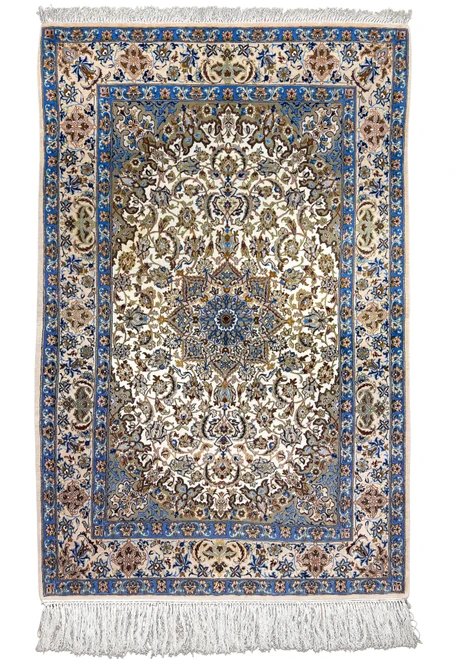
Isfahan weavers work in ivory, red and navy, and a powder blue field is something you see once in a long while. This 3'6" x 5'2" rug carries the woven cartouche Iran Isfahan Davari on its end band between 2 small flags, and it is knotted at 680 to 700 knots per square inch in wool and silk on a pure silk foundation, the top of what the city produces. The design is as unusual as the color: one long lobed medallion with a navy heart floats on an open field of pale blue, and instead of a straight border the cream frame steps inward at every corner in a bracket outline, so the field reads as a blue panel set into a cream mat. The silk is everywhere in the drawing, in the outlines of every palmette, the vines and the medallion flowers, and it catches the light differently from every side of the room. The rug has never been on a floor, the pile is full, the long cream silk fringes are intact, and the selvages are bound in navy. A certificate of authenticity from Rugs.net accompanies the rug.
Design and Motifs
The medallion is drawn as a tall pointed oval, and it is built from the inside out. At the very center a midnight navy lozenge holds a rosette in gray, ivory and salmon with a burgundy heart, and 4 salmon and rose peonies on chestnut stems, each one guarded by a pair of split leaves drawn as chestnut arabesques with silk outlines. Around the navy heart the medallion is open blue, and its outline is a loose wreath of chestnut vines that curl into hooks and carry Shah Abbas palmettes in burgundy and salmon, lotus flowers, gray-blue rosettes and moss green leaves, so that the medallion has no hard edge and dissolves into the field at its lobes. A pointed pendant of salmon and gray hangs from each end. The powder blue field around it is mostly bare, which is rare for Isfahan, and is scattered only with sprays of ivory and salmon blossoms, a pair of burgundy and navy boteh near each corner, and small gray-blue rosettes. The cream border is the invention: instead of running straight it steps inward at the 4 corners in a chestnut-outlined bracket, cutting a rectangular notch into the field, and at the top and bottom center it dips inward again around a sky blue and burgundy cartouche. Inside the cream ground a running vine carries salmon and rose blossoms, gray-blue lotus flowers and olive leaves, and at the middle of each long side sits a large sky blue medallion cartouche in navy and burgundy. A narrow sky blue guard with navy and burgundy rosettes and a wide plain midnight navy selvage close the frame, and the Davari cartouche sits on the cream end band between the 2 flags.
Colors of This Powder Blue and Cream Isfahan Rug
The field is a powder blue, a pale, slightly gray blue that reads as duck egg in daylight and as a cool silver under lamps, and because most of it is left open it is the color you see first from across the room. The border is a warm cream with a faint peach cast, the color of old parchment, and it is the second largest area on the rug. Between them the drawing is done in a palette of soft, dusty tones: salmon and a deeper rose pink in the peonies and blossoms, a burgundy wine in the boteh, the flower cores and the cartouche outlines, a chestnut brown for every vine and arabesque, olive and moss green in the leaves, a gray-blue in the rosettes and the smaller flowers, and a plum in the shadows of the palmettes. The medallion heart and the 2 side cartouches are a sky blue a step brighter than the field, and the medallion core, the outer selvage and the finest outlines are a midnight navy that reads as black. The silk sits in the ivory and pale outlines and in the peony petals, which is why the medallion flashes in the angled photographs while the blue field stays soft. The back shows every color slightly lighter with no bleeding, and the knot rows are so fine they read as cloth.
Isfahan at 700 Knots and the Davari Name
Isfahan in central Persia has been a court weaving city since the Safavid workshops of the 16th century, and its reputation rests on drawing: the curved line, the flowing vine and the exact mirror of a motif across the field. At 680 to 700 knots per square inch on a silk foundation this rug sits at the very top of the city's output, the density at which a weaver can draw a peony petal in 3 shades and a vine a single knot wide. Davari is one of the celebrated Isfahan master names, and the workshop's cartouche between 2 flags marks a piece it chose to sign, which on a rug of this fineness is the difference between a good Isfahan and a collector's Isfahan. A signed Davari in an ivory or red palette is a fine thing; one in a powder blue field with a stepped border is, as far as we know, unique, and it is the kind of piece that is bought as a work of art rather than a floor covering. Our Isfahan rug guide covers the city and its grades. Among 3x5 Persian rugs it belongs in a study, a bedroom or on a wall, and the pale palette makes it one of the few fine Isfahans that sits easily in a light, modern room.