
| Size in ft: | Width: 6'9" x Length: 10'3" |
| Size in Inch: | Width: 81" x Length: 123" |
| Size in meters: | Length: 3.12 x Width: 2.06 m |
| Colors: | Ivory, Midnight Navy, Cornflower Blue, Madder Red, Rose Pink, Gold, Sage Green, Violet |
| Shape: | |
| Woven: | 100% Hand-knotted | Handmade |
| Foundation: | |
| Pile: | |
| KPSI: | |
| Signature: | Davari |
| Design: | All-Over Floral | No Medallion |
| Origin: |
Persian Isfahan | Made in Persia |
| Condition: | Excellent | Never used |
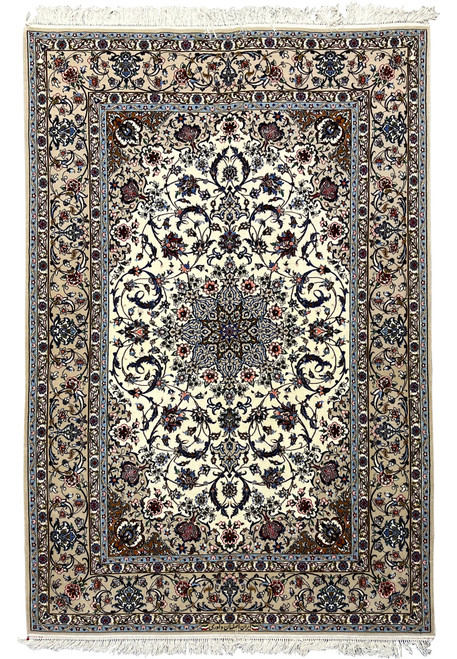
6'9" x 10'3" Persian Isfahan Rug | Signed Davari | All-Over Floral | Kork Wool on Silk
There is no medallion in this rug, which means there is nowhere for the eye to rest and nowhere for the weaver to hide. The ivory field of this 6'9" x 10'3" Isfahan carries one continuous vine system from fringe to fringe, drawn in fine madder red line, and every arc of it has to close correctly against its mirror on the other side of the rug. It is woven at approximately 525 to 560 knots per square inch in kork wool on a silk foundation, which is why the ivory reads as lit rather than flat and why a rose petal here is the width of a fingernail and still shows its shading. A woven signature sits in the end border. It ships with a certificate of authenticity, and in trade terms it sells among 7x10 Persian rugs.
Design and Motifs
The field is built on a lattice of dark red vine stems that arc away from a vertical center line, cross, and close again into large ogee compartments, with a hair-thin sage green tendril shadowing each red stem and filling the space between. Down that center line runs the rug's largest motif, a cornflower blue lobed palmette filled with gold arabesque scrollwork and finished with curling ivory clasps at the shoulders, repeated at intervals up the whole length and answered above and below by a smaller blue lotus. Inside every compartment the drawing changes: sprays of gol farang roses in madder red with pink and gold shading, orange faced daisies with pale blue centers, violet asters, blue and ivory star flowers, and serrated saz leaves in sage and grey blue that curl back on themselves. Nothing is stamped and repeated at random. The field mirrors precisely across both axes, so the same rose appears left and right at the same height, and the small ivory buds that sit on the thin green tendrils are placed to fill the gaps the roses leave. The border stack is five bands deep. The wide navy main border carries its own turning vine of palmettes, roses and lotus heads, interrupted at the center of each side and at each corner by a pointed ivory cartouche filled with blue and gold flowerheads. Flanking it are two ivory guard borders of alternating red and blue blossoms on a fine dark vine, and the outermost band is the classic pale blue and ivory reciprocal interlace that Isfahan uses to finish an edge. The signature cartouche is worked into one end band, in dark script on ivory.
Ivory, Midnight Navy and the Blue Palmettes
The field is a clean ivory, closer to cream than white, with no yellow cast and no abrash across the full 10 feet, and it is the reason the rug reads as bright even under a navy border this dark. That border is a midnight navy that goes almost black in low light, and it is the only heavy color in the rug, which is what gives the ivory its lift. Between those two extremes the palette is unusually cool for a Persian rug: cornflower and sky blue in the big palmettes and in half the small blossoms, softened by gold and apricot in the arabesque work inside them. The warm notes are placed rather than spread, a madder red that shades to rose and blush in the gol farang roses, an orange daisy here and there, a violet aster, and the thin red vine line itself, which is the single color that touches every part of the field. Sage and moss greens carry the leaves, taupe and grey blue outline the larger flowerheads, and near black outlines every motif at one knot wide, which is what keeps the drawing crisp against so much ivory. The ivory guard borders repeat the field color so the navy is framed on both sides rather than sitting hard against the edge, and the fringe is ivory and untouched.
The Isfahan Weave and the Signature
Turn the rug over and the 525 to 560 knots per square inch explain the drawing. The knots sit in even ranks on a silk foundation, tight enough that the reverse shows the same rose, the same daisy and the same blue palmette that the face does, at full detail, with the silk warps visible as fine pale lines through the back. Kork wool, the soft fleece taken from the neck and shoulders of the lamb, takes dye deeper than ordinary wool and clips to a low even pile, so the ivory has sheen and the outlines stay sharp instead of blurring at the edges. That combination of kork on silk at this knot count is what Isfahan rugs are known for, and it is the only way a field with no medallion works, because a curved vine that runs 10 feet without a center to anchor it will show every mistake at this scale. The end border carries the workshop signature, which is the weaver putting his name to a rug that had nowhere to hide.