
3'7" x 5'6" Persian Isfahan Rug | Signed Davari | Ivory Vase Repeat, Wool and Silk on Silk Foundation
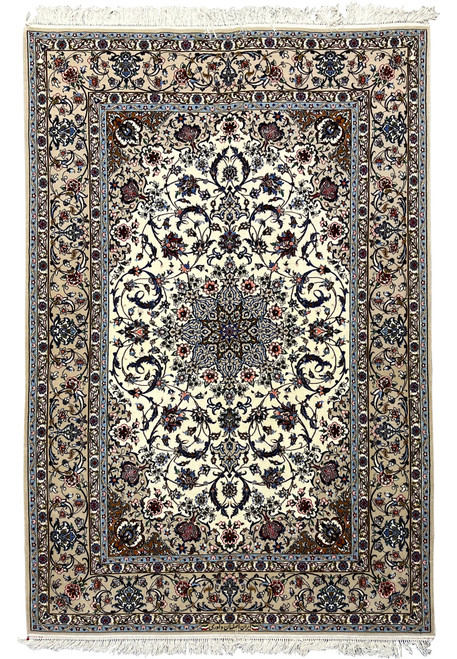
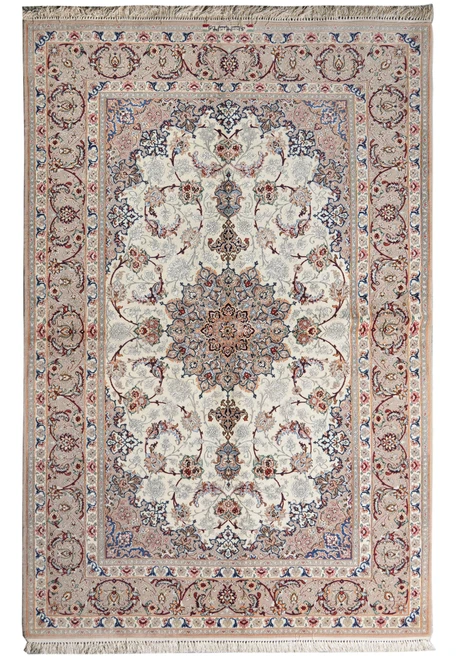
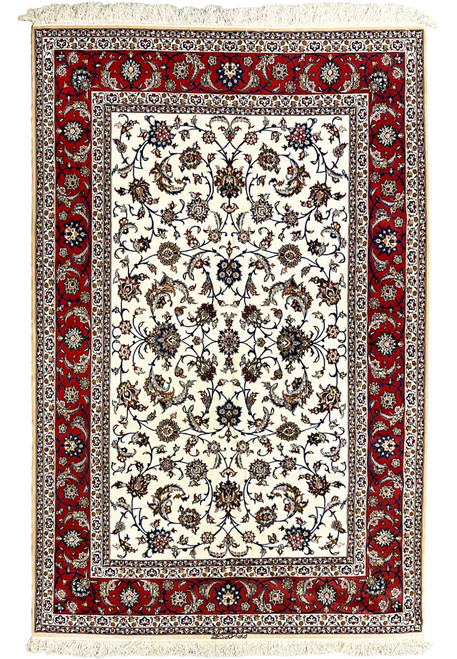
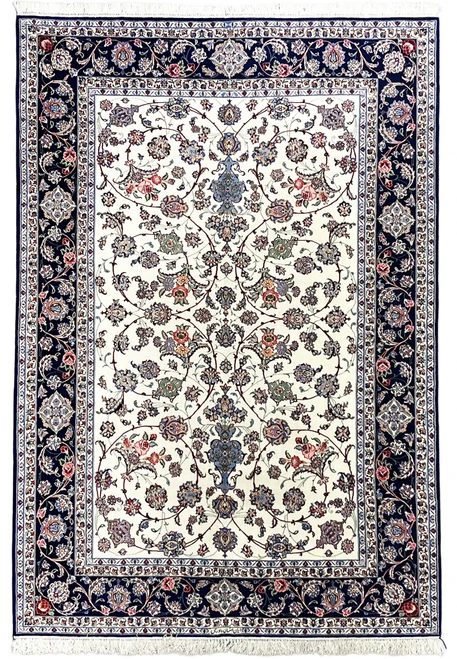
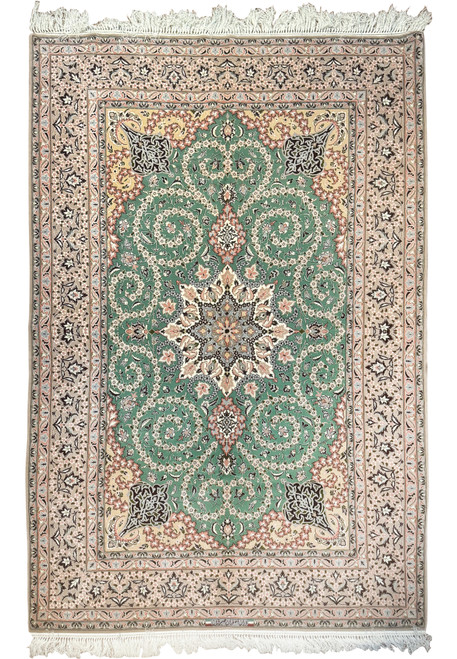
Most Isfahans put a medallion in the middle and build outward. This one does something rarer: 30 identical vases of flowers, set in 6 rows of 5, march across an ivory field whose ground is itself a second pattern, a taupe damask woven in silk so that it shows and disappears as you move around the rug. It is a 3'7" x 5'6" piece signed in the end border with the woven cartouche Isfahan Davari, flanked by 2 small woven flags, and it is knotted at 480 to 500 knots per square inch in wool with silk on a pure silk foundation. Every flower on the rug is outlined or filled in silk, which is why the vases glint in the angled photographs and the damask ground shifts from taupe to silver. The rug has never been on a floor, the pile is full and even, the ivory silk fringes are intact, and the selvages are bound in leather on the back. A certificate of authenticity from Rugs.net accompanies the rug.
Design and Motifs
Each vase is a small composition in itself. The body is a navy urn drawn in arabesque outline with a gold filigree inside it, a tiny ivory cartouche with a burgundy eye at its center and 4 curling navy handles, standing on a striped blue foot. From the mouth of the vase rises a bouquet: a fan of teal and olive serrated leaves, 2 lavender blue tulips, a burgundy and pink palmette with a gray lotus core, salmon side blooms, and a single burgundy bud at the very top, with a burgundy rosette sprig and a salmon curled leaf hanging from either side. The 30 vases are identical and sit in a staggered grid, and between them the ivory ground carries a continuous damask of taupe palmettes, split leaves and lattice vines, drawn in a single tone so that it reads as texture rather than pattern and gives the vases something to float on. A cinnamon guard with an ivory acanthus vine and gray flower buds frames the field on both sides of the main border. The main border is ivory and is built from alternating cartouches: a taupe and gray arabesque cartouche with a lobed shield at its center and a gray blue palmette on either side, then an open ivory panel holding a pink and burgundy rose with a gold heart, blue 5-petal blossoms and teal leaves, each panel framed by taupe scrolling leaves that curl in on themselves. A thin burgundy outer stripe closes the design, and the Davari cartouche sits on the ivory end band outside the border.
Colors of This Ivory and Navy Isfahan Rug
The field is a warm ivory, the color of heavy cream, and it is the largest color on the rug by a wide margin, which is what keeps 30 vases from feeling crowded. The damask on it is a taupe with a gray cast, woven in silk, and it is the color that changes most with the light: flat on, it is a shade darker than the ivory and almost invisible; at an angle, the silk catches the light and the whole ground turns to a pale silver brocade. The vases are a deep navy, the darkest color on the rug, and their filigree is a mustard gold worked in silk, so navy and gold is the accent you see from across the room. Inside the bouquets the palette is soft and slightly muted: a burgundy and a wine red, a dusty rose pink, a salmon peach, teal and olive green in the leaves, and a lavender blue in the tulips. The border repeats the taupe and the ivory of the field, with gray blue palmettes, a cinnamon brown in the guards, and the same rose pink and burgundy in the corner flowers, and a thin line of burgundy outlines every cartouche. The back shows every color slightly lighter with no bleeding, and the knot rows are fine and even.
The Vase Design and the Davari Workshop
The repeating vase is one of the oldest layouts in Persian weaving, descended from the Safavid vase carpets of the 17th century, and Isfahan workshops revived it in the 20th century as a way of showing off their drawing without the crutch of a medallion. It is a harder design to weave well than it looks: every vase must match its neighbor to the knot, and a damask ground drawn in one color leaves nowhere to hide an error. That is why it is usually reserved for silk-foundation pieces at 450 knots per square inch and above, where the weaver can draw a tulip petal or a vase handle a single knot wide. Davari is an Isfahan workshop name, and a signed cartouche with the flags on either side marks a piece the workshop was willing to put its name to; on an Isfahan rug of this fineness it is the difference between a good rug and a collector's rug. Among 4x6 Persian rugs the neutral ivory and taupe palette makes it one of the easiest fine Isfahans to place in a modern room, on the floor of an entry or beside a bed, or on a wall.