6'6" x 10' Persian Bijar Rug | Mahi Design | Navy Herati Lozenge | Ivory Medallion
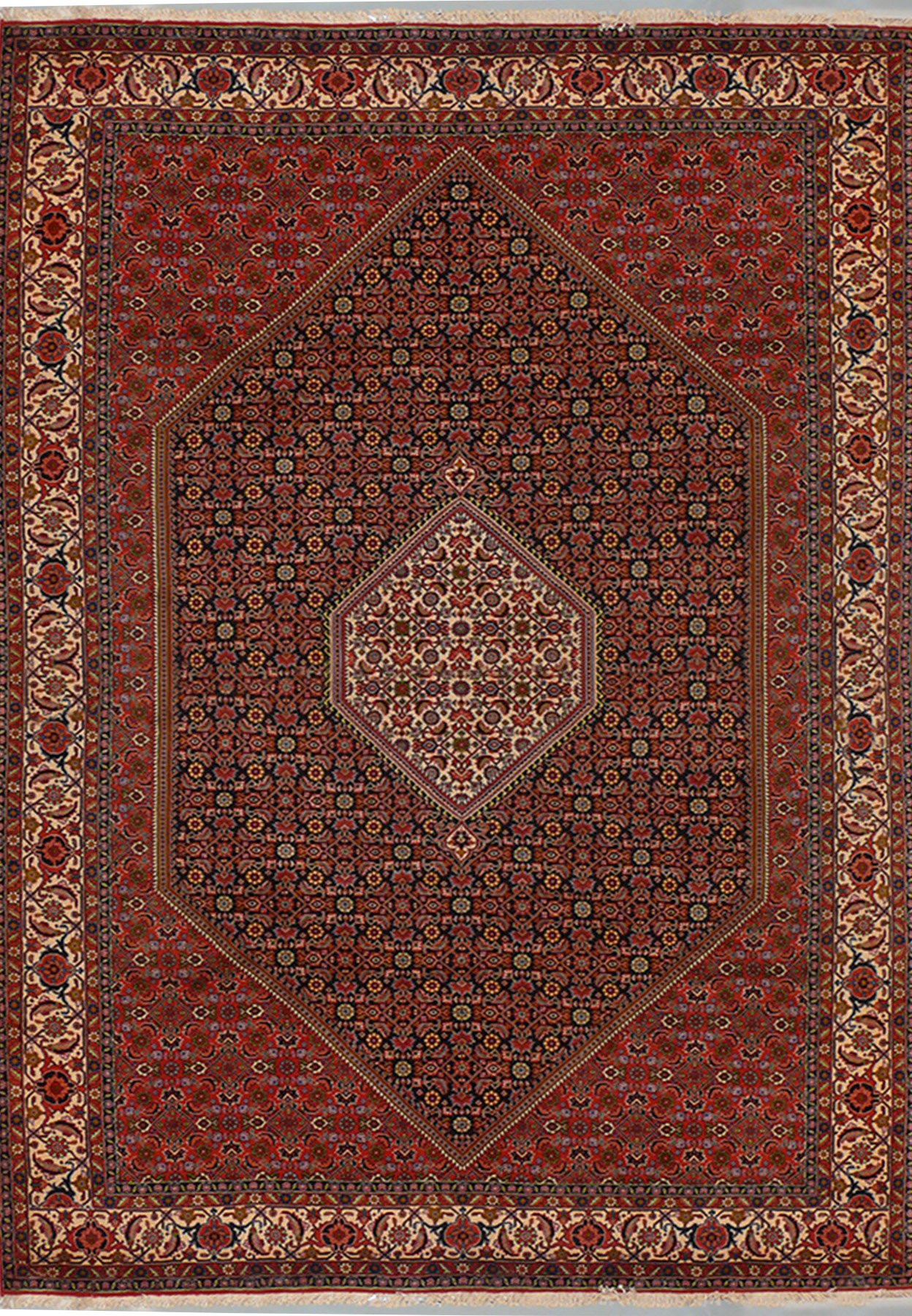
Most Bijars in this layout put red at the center. This 6'6" x 10' rug turns the scheme around, with a deep navy lozenge set inside rust red corners, which gives it a cooler, more tailored look. It is hand-knotted in wool on a cotton foundation at approximately 340 to 360 knots per square inch, fine by Bijar standards, and it has never been used. Among 7x10 Persian rugs it is a strong choice for a living room seating group, a bedroom or a dining area for 6. It ships with a certificate of authenticity recording origin, materials and knot count.
Design and Motifs
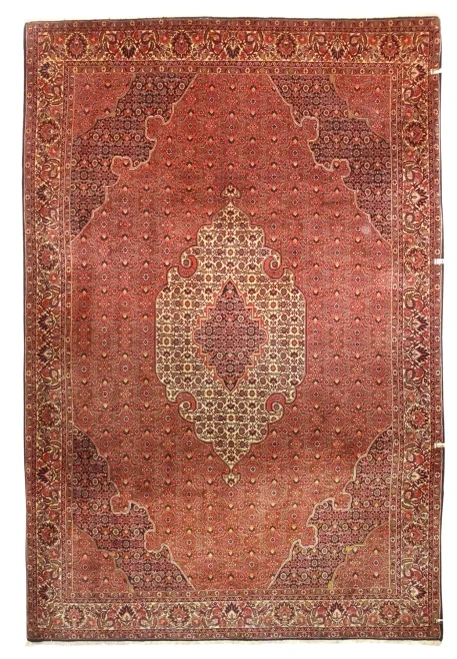
The field is a large navy lozenge with long straight sides and pointed ends, outlined in a fine olive and ivory line. It sits on a rust red ground that fills the 4 corners. At its center is an ivory hexagonal medallion. All 3 zones are covered in the mahi pattern, also called herati or fish: a rosette framed by 4 curved leaves within a small diamond, repeated in an even lattice. On the navy lozenge the lattice is fine and close, on the ivory medallion it opens up so each rosette is easy to see, and on the rust corners it shifts to a slightly larger scale. The main border is ivory, with large red and navy palmettes linked by curling leaves, set between narrow red and navy guard stripes.
Navy, Rust Red and Ivory
Navy blue dominates, a deep, almost inky tone that reads calm and formal in a room. Across it the mahi lattice is drawn in rust red, rose red and ivory with small turquoise, light blue and green rosettes, so the dark field sparkles with color up close. The rust red corners frame the navy with warmth, their lattice picked out in navy, purple and brown. The ivory medallion is the brightest point in the field, worked in red, navy and olive green. The wide ivory border then repeats that light tone around the whole rug, so the composition moves from light at the edge, to warm red, to deep navy, and back to light at the center. It is a balanced palette that sits well with both traditional wood furniture and cleaner, modern pieces.
Bijar Weaving in the Gerus Region
Bijar is a small Kurdish town in the Gerus region of western Persia, an area of cold winters and mild summers, and it has an international reputation far larger than its size. Most of its rugs are woven by Kurdish and Afshar weavers, and the trade draws a line between the town workshop pieces and the Tekab-Bijar rugs made by the Afshar tribe nearby. Both share the technique that defines Persian Bijar rugs: damp wool, symmetric knots and wefts beaten down so hard that the warps sit on 2 levels and the rug becomes stiff and heavy. That construction is why Bijars are called the iron rugs of Persia. This one adds fine 340 to 360 knot drawing and an unused pile, so it is ready for decades of use.