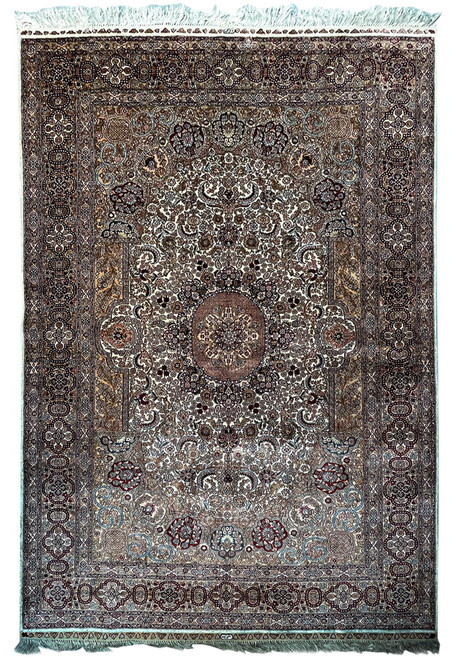

6'10" x 10'1" Persian Qum Silk Rug | Garden Panel Medallion with Animals
Silk on silk, pile and foundation both, at roughly 645 knots per square inch: that is the short version of what this 6'10" x 10'1" Persian Qum is. The long version takes a while, because the weaver filled 16 separate garden panels with trees, birds and grazing animals and then set a glowing gold medallion field in the middle of them. The pile is sheared low so the drawing reads like printed line work, and the surface shifts from deep to luminous as you walk around it. At this width it works as a formal centerpiece in a room where it will be seen rather than walked across in boots, and it sits at the lower end of large Persian rugs without needing a vast floor to justify it. It is in excellent condition and has never been used. A certificate of authenticity from Rugs.net accompanies the rug.
Design and Motifs
The layout is the classic Qum garden panel, or kheshti: a grid of small compartments, each outlined in an ivory ribbon border, each holding its own miniature scene. There are 16 of them, 5 across the top, 5 across the bottom and 3 down each side, and the top and bottom rows plus the middle panel on each side are drawn as arched niches with a flowering tree rising from the base, flanked by deer, gazelles, rams and long-tailed birds. Others are pure blossom and vine. At the center the grid opens into a large gold field carrying 4 oversize boteh paisleys in its corners and a dense scroll of flowering stems, and inside that sits an oval navy medallion filled with a slender tree, perched birds and small red blossoms. The main border repeats the animal theme at larger scale, with pairs of deer and running hounds moving through flowering branches on a midnight ground, framed by ivory guard stripes of turning palmettes. A small green cartouche sits at the top end of the rug, woven in as part of the composition. Nothing here is a repeat motif stamped out; the panels differ one from the next, which is the point of the design.
Colors of This Midnight Navy Qum Rug
The dominant ground is a very dark midnight navy, close to black where the light falls away and clearly blue where it catches, and it is used for the panels, the main border and the medallion alike. Against it the center field reads warm camel gold, softening to apricot at the edges, which is what gives the rug its glow from across a room. The small-scale drawing runs through rust and brick red, deep burgundy, clean ivory and cream, sky blue, a pale sea green and sage, with occasional lilac and mustard in single blossoms. Brick and terracotta grounds appear in some of the panels, breaking the navy grid into bands. The animals are worked in sand, fawn and cream so they lift cleanly off the dark ground. Because the yarn is silk, each of these colors carries a directional sheen: turn the rug and the gold deepens while the navy lightens.
Qum Weaving and the Case for Silk
Qum, south of Tehran, is a relatively young weaving city by Persian standards and it built its reputation almost entirely on fineness rather than tradition. The workshops there are known above all for Persian silk rugs, and the rivalry between them is what keeps the standard where it is. Silk in the warp as well as the pile is the technical reason this rug can hold detail at this scale: a thinner, stronger foundation lets the weaver pack the knots tighter, and at approximately 645 knots per square inch the curve of a bird's tail or the outline of a gazelle's leg can be drawn in 2 or 3 knots instead of a blocky step. The reverse, shown against a ruler in the photographs, is as crisp as the face. Buyers comparing this piece against other 7x10 Persian rugs or the rest of our hand-knotted Persian and Oriental rugs will find few that carry this much drawing in this much space.