
| Exact Size in ft: | Width: 10' x Length: 13'3" |
| Size in Inch: | Width: 120" x Length: 159" |
| Size in meters: | Length: 4.06m x Width: 3.05m |
| Some of many colors: | Midnight Navy, Crimson, Ivory, Rose, Teal, Sage, Gold, Coral, Cream |
| Shape: | Rectangular |
| Woven: | 100% Hand-knotted | Handmade |
| Foundation: | 100% Cotton |
| Pile: | 100% Kork Wool |
| KPSI: | 280 - 300 |
| Origin: | Persian Qum | Made in Persia |
| Condition: | Excellent | Never used | about 30-4 years old |
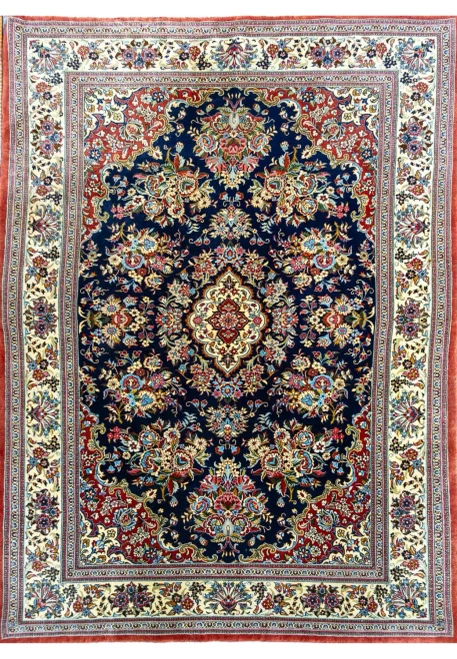
10x13 Persian Qum Kork Wool Rug | Midnight Navy Field | Layered Medallion Ivory Spandrels | 280-300 KPSI
A hand-knotted Persian Qum rug in pure kork wool, woven at 280 to 300 knots per square inch in the formal Qum city style, with a midnight navy field, deep crimson border, ivory cartouche spandrels at all four corners, and a layered floral medallion at center built in red, ivory, and teal blue. This piece is approximately thirty to forty years old, in unused mint condition, and at 10' x 13'3" it falls into a size that is genuinely rare for fine Qum kork production. Most Qum kork workshops cap out around 8x11 because the knot count makes larger pieces prohibitive to weave on commission, so a 10x13 in this quality range with no wear is a meaningful find.
Design and Motifs
The center medallion is the technical showpiece of this rug, layered through four distinct tiers of drawing. A small teal blue starburst rosette sits at the absolute core, framed by an ivory cartouche of curling vine, then a wider crimson lobed field of palmette and scroll work, finally an ivory outer cusped boundary with red pendant cartouches dropping above and below into the navy field. The four corner spandrels mirror that vocabulary in inverted color, ivory grounds with the same dense scroll, palmette, and rose vocabulary that the medallion carries. What sets this rug apart from a standard Qum is how the field is drawn instead of repeating palmettes on a grid, the navy ground holds a free-flowing arrangement of floral sprays, scrolling vines, and small rose bouquets, each spray drawn with individual botanical care rather than copied stencil. The main border carries a dense crimson scroll of palmettes and rosettes, framed by an ivory minor border of vine and small flower heads, with twin twisted rope guards on the outermost edges.
Colors and Placement
The dominant relationship is midnight navy against crimson, with the four ivory spandrels and the layered ivory tiers of the medallion providing the lift that keeps the rug from feeling closed in. The smaller accent colors are where the rug reveals its Qum character teal blue at the medallion core, soft rose and coral in the floral sprays, sage green and gold for leaf work, all sitting against that deep navy ground without ever feeling busy. Pure kork wool takes dye with more depth than standard wool, which is why the navy reads as truly midnight rather than washed out, and why the crimson border has the saturation of red velvet rather than flat red. At 10' x 13'3" the rug is sized for a formal dining room comfortably seating ten to twelve with chairs drawn back, a large living room anchoring sofa and two chairs with the full medallion centered on the seating arrangement, or a library where the field is meant to be walked around as much as walked on.
Origin and Construction
The city of Qum sits about 90 miles south of Tehran and is the youngest of the major Persian weaving centers, with serious production only beginning in the 1930s. What Qum lacked in historical tradition it made up for by attracting the finest weavers from Kashan, Isfahan, and Nain, who brought the highest-end techniques with them. Kork refers specifically to the wool taken from the underside and shoulder of lambs, the softest and shortest fibers the animal produces, which is what allows weavers to pull the kind of fine detail this rug shows. This piece is hand-knotted in 100% kork wool pile on a cotton foundation at 280 to 300 knots per square inch, putting it firmly in the top tier of Qum kork production, just below the silk-pile work that the city is also famous for. Despite the rug being roughly thirty to forty years old, it has never been laid on a floor and arrives with full pile, intact selvages, clean fringe, and the original saturated dye depth. For deeper context on Qum weaving, including how kork compares to Qum silk and what to look for in knot count, our complete guide to Qum rugs covers it in detail.