
| Exact Size in ft: | Width: 10' x Length: 12'10" |
| Size in Inch: | Width: 120" x Length: 154" |
| Size in meters: | Length: 3.93m x Width: 3.05m |
| Some of many colors: | Deep red, navy, ivory, salmon coral, pale celadon blue, soft pink, gold, emerald green |
| Shape: | Rectangular |
| Woven: | 100% Hand-knotted | Handmade |
| Foundation: | 100% Cotton |
| Pile: | 100% Wool |
| KPSI: | 320 to 360 |
| Origin: | Persian Senneh | Made in Persia |
| Age: | Approximately 35 to 40 years |
| Condition: | Excellent | Never used |
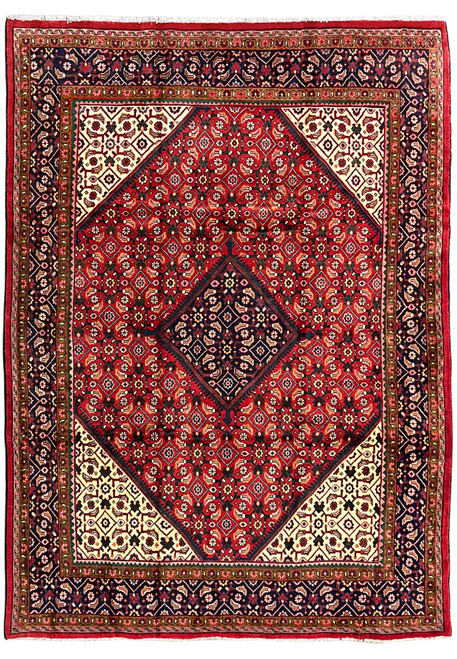
10 x 13 Persian Senneh Rug, Stepped Diamond Medallion with Fine Herati Field and Coral Palmette Border, 320 to 360 KPSI Wool on Cotton
A genuinely fine Persian Senneh at a true 10 by 13 room size, woven in 100% wool on a 100% cotton foundation at 320 to 360 KPSI. The rug is approximately 35 to 40 years old and has spent its entire life rolled in storage, so it presents essentially as a brand new piece despite the patina that only properly aged Kurdish wool develops. Senneh is the historic name for the city of Sanandaj in Iran's Kurdistan province, and it is also the origin of the term "Senneh knot," the asymmetric Persian knot used in the finest Persian weaving. For background on the Kurdish weaving tradition and how Senneh sits alongside its more rugged cousin Bijar, see our guide to Persian Kurdish rugs.
Design and Motifs
The composition is built around a sequence of stepped diamond medallions nested inside one another, an instantly recognizable Senneh signature. The innermost diamond reads pale ivory, framed by a deep red diamond field, then a second nested ivory diamond, and finally the dark navy and red main field with four matching stepped diamond spandrels anchoring each corner. Across the entire surface of the field, including inside every nested diamond, the weaver carries the classic Senneh fine herati repeat, the design known elsewhere in Persia as mahi or "fish in pond," composed of tiny diamond cells with rosette centers, rotated leaf brackets, and small floral fillers. At 320 to 360 KPSI the scale of this repeat is genuinely fine, the individual herati cells are small enough that the field reads as a continuous shimmering pattern rather than a discrete one. The main border sits on a soft salmon coral ground and carries large palmettes, rosettes, and serrated leaves in red, navy, ivory, and gold, framed on both sides by multiple narrow ivory and pale celadon-blue guard borders running delicate rosette chain repeats.
Colors and Placement
The Senneh palette is distinctive and immediately readable. Deep red and navy carry the field, ivory and pale celadon sky blue open up the negative space inside the stepped medallions, and a soft salmon coral defines the main border. Through the herati repeat run small accents of pink, gold, and emerald green that keep the whole composition lively at close range without overwhelming it from across the room. The pile is finely cropped, in the Senneh tradition the wool is woven thin and trimmed close to keep the drawing legible at this knot density, which gives the rug an unmistakable hard-handled feel and exceptional clarity in the herati cells. At 10 by 12'10 this is a true 10x13 room size, comfortable under a 10 to 12 seat dining table with chairs pulled back, anchoring a primary living room with the front legs of all major furniture on the rug, filling a primary bedroom centered around the bed, running end to end down a library or great room, or laying as a statement floor in a formal foyer, executive office, or hotel lobby. The Senneh palette of deep red, navy, ivory, and salmon coral reads beautifully against medium and dark wood floors, formal millwork, oil paintings, antique furniture, and works at the foundation of formal traditional, English manor, Georgian, federal, and old-world transitional interiors.
Origin and Construction
Senneh, the historic name for the city of Sanandaj in Iran's Kurdistan province, is one of the most significant weaving centers in Persia for two reasons. First, the city gave its name to the Senneh knot, the asymmetric Persian knot that underpins the finest Persian weaving traditions. Second, Senneh weavers developed their own distinctive aesthetic, finer in knot count than any other Kurdish weaving, lighter and thinner in pile than the famously dense Bijar, with stepped geometric medallions and a precisely drawn herati field. This particular piece is fully hand-knotted in 100% wool on a 100% cotton foundation at 320 to 360 KPSI, approximately 35 to 40 years old, and remarkably it has spent its life rolled in storage rather than under furniture. The pile is full and crisp, the colors are fresh and saturated, the foundation is clean and even on the reverse, and the rug presents essentially as a new piece with the maturity of properly aged Kurdish wool and natural dyes. Finely woven Senneh rugs in this size, knot density, and condition are increasingly difficult to source.