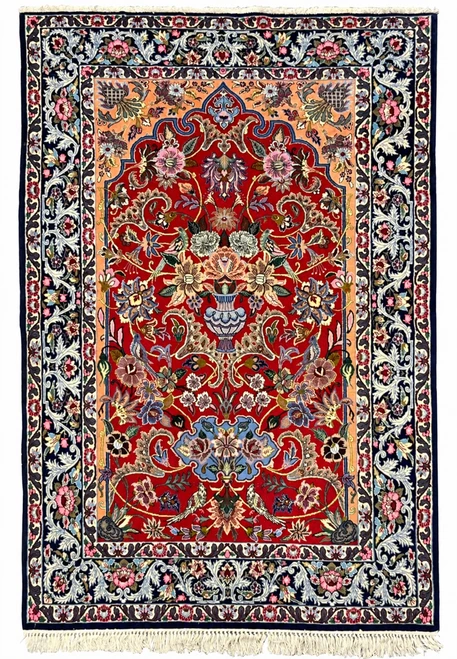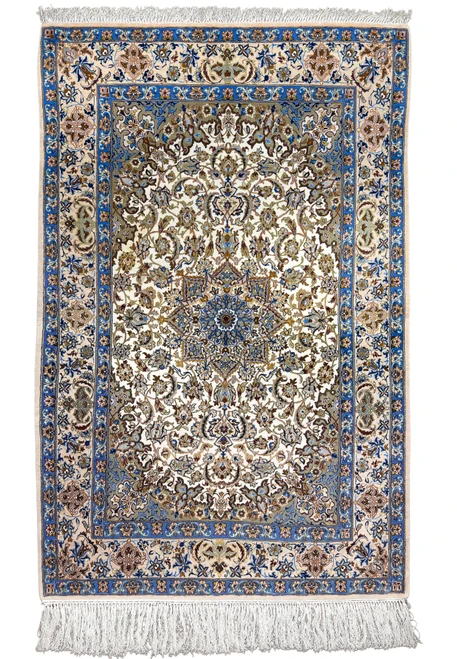

3'8" x 5'8" Persian Isfahan Rug | Signed Dardashti | Songbirds and Lavender Paisley Medallion on Camel
You will not find this composition in a stack of ordinary Isfahans. It is a 3'8" x 5'8" Persian Isfahan signed by the Dardashti workshop: its woven cartouche reads "Iran Isfahan Dardashti". Dozens of songbirds wheel around a lavender medallion of paisley forms, a geometric strapwork frame boxes in the camel field, and ivory arabesque panels fill each corner. It is woven in kork wool and silk on a silk foundation, at 25 knots to the inch, or about 620 to 640 knots per square inch. Every feather, every curl of acanthus and every bead in the pearl strings is drawn cleanly. The piece has never been used, and it comes with our certificate of authenticity. This is a true collector's piece.
Design and Motifs
The medallion is a large oval built from paisley (boteh) forms. Ivory boteh filled with tiny rose and lavender blossoms curl around one another over a lavender ground, laced together by fine navy scrollwork. At the very center, a crimson lattice-filled star with a navy flower head pins the whole design together, and ivory palmettes mark the medallion's 4 points. Outside the oval, sweeping acanthus fronds in taupe and chocolate brown reach toward each end, strung with lilac pearl chains and framed by ivory and powder blue lily sprays. Then come the birds. A ring of songbirds in flight circles the field: some with crimson wings, some in olive and brown, some in blush and lilac, others perched in pairs beak to beak above the end borders. Beyond them, a lavender-blue strapwork band of interlacing geometric knots frames the field on all 4 sides. It meets ivory corner panels of taupe arabesque leafwork. The main border is a narrow camel band where a twisting blue and burgundy ribbon wraps small ivory leaf rosettes.
The Colors: Camel, Lavender and Ivory
The field is a warm camel, a soft fawn tan with a slight rosy cast. It is an unusual ground for a fine Isfahan and gives the rug a quiet, honeyed glow. Against it the medallion sits in lavender, a dusty lilac-blue that the silk turns almost luminous when light crosses it. Ivory is the third key tone, filling the paisley forms, the corner panels and the lily sprays, so the whole design feels light. Navy outlines the medallion and the strapwork knots and gives the drawing its precision, while the deep crimson at the very center is the single strongest color in the rug, used with restraint. The acanthus fronds move through taupe, mushroom and chocolate brown. The birds carry the brightest accents: crimson and burgundy wings, forest and olive green, blush pink, a touch of orange at the beaks, and plum and soft grey in the feathers. Powder blue runs through the lily sprays and the border ribbon. The fringe is the natural ivory of the silk foundation.
Dardashti and the Workshops of Isfahan
Isfahan's weaving reputation goes back to the Safavid court workshops of the 16th century, and the city still judges its weavers on drawing above all. The signed workshops are where that standard lives, and a woven name like Dardashti is the workshop putting its reputation on the piece. Pictorial work with birds is one of the hardest tests of an Isfahan weaver. Feathers, wings and beaks need far more precision than a repeating floral, which is why a design like this is rarely attempted and even more rarely done well. The silk warps make it possible: they are thin and strong, so knots pack tightly and the rug stays flat and square. Kork wool, the soft fleece from the lamb's neck and shoulders, gives the pile its fine hand and natural luster. At 620 to 640 knots per square inch, this signed Isfahan Persian rug belongs with the best small pieces the city produces. It deserves a place where it can be seen up close, on the floor of a quiet room or framed on a wall.