
3'8" x 5'8" Persian Isfahan Rug | Signed Naeil | Ivory Garden of Urns Songbirds and Cranes | Wool and Silk on Silk
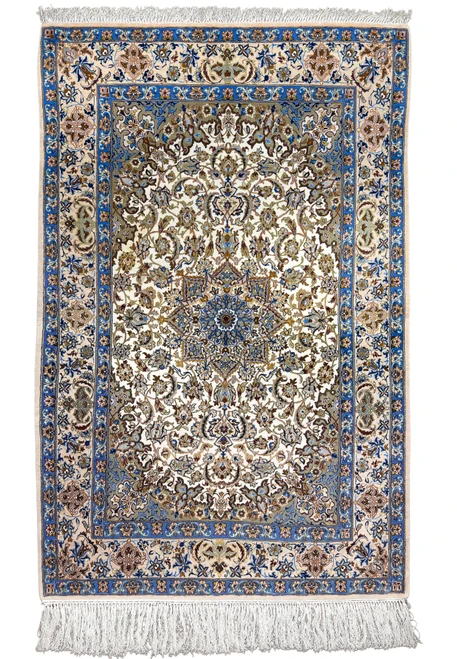
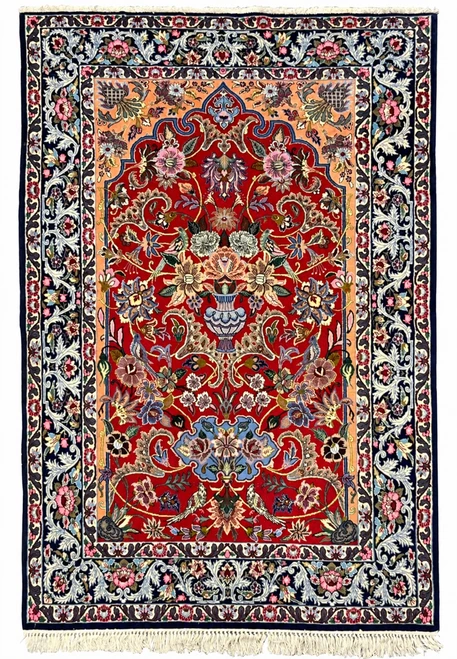
Most Isfahans are built around a single medallion. This one is a garden: 7 carved urns stand around the ivory field, a planter bowl overflows with flowers at the base, songbirds fly between the branches, and a pair of cranes wades through the reeds in the bottom corners. The woven signature at one end reads "Isfahan Naeil". It is not one of the famous workshop names, but the drawing, the weave and the unusual layout make this 3'8" x 5'8" Persian Isfahan rug a real collector's piece on its own merits. It is hand-knotted in wool and silk on a pure silk foundation at 680 to 700 knots per square inch, with an unusually large amount of silk worked into the flowers. It has never been used, and it comes with our certificate of authenticity.
Design and Motifs
The composition grows upward from a powder blue flower bowl at the bottom center, its body dotted with tiny blossoms and its rim edged in a band of ivory scrolls. Out of it rise slender navy stems carrying blue, ivory and camel blossoms, which climb to 2 lobed medallion forms on the central axis. These are taupe arabesque shapes outlined in navy and filled with royal blue flowers, the upper one tipped with a small pointed crown. On either side, 6 more urns stand in a mirrored column, each with a camel and chocolate openwork body, a pointed lid and a small lattice base in grey blue. Between them, long-tailed songbirds hover in pairs, sweeping red-brown fronds curl like feathers, and the ground is filled with small blue and olive blossoms on fine navy stems. In the 2 lower corners, a tall crane stands in the reeds, a detail you only notice up close. The camel main border carries its own flight of birds among palmette medallions in navy, royal blue and chocolate. It is framed by chocolate brown guard stripes of blue lotus flowers and pale grey leaves, with the signature woven into the plain camel band at the end.
The Colors: Ivory, Camel and Royal Blue
The field is a warm, creamy ivory that keeps the whole rug light and calm. Camel, a soft sandy tan, fills the main border and the medallion forms, and chocolate brown deepens the urns and the narrow guard stripes, so the frame reads in 2 warm earth tones around the pale center. Against those neutrals, royal blue is the brightest note: it appears in hundreds of small flowers across the field and border, and because so much of that blue is silk, it flashes with a real sheen as the light moves. Navy outlines the drawing and the stems. Powder blue and grey blue color the flower bowl, the urn bases and the cranes, while olive green brings in the leaves and touches of burgundy and red-brown warm the fronds and birds. The overall effect is cool and elegant, a quieter palette than the red and navy most buyers expect from Isfahan. The fringe is the natural ivory of the silk foundation.
A Lesser-Known Signature with First-Rate Weaving
Isfahan, in central Persia, inherited the Safavid court weaving tradition of the 16th century, and today its workshops range from celebrated houses to smaller signed ateliers like Naeil. The name on a rug is only part of the story. What collectors judge is the drawing and the weave, and here both are exceptional. At 680 to 700 knots per square inch on silk warps, the knots are packed tightly enough to give each songbird a beak and tail feathers and each urn its fine openwork. Silk foundations keep the rug flat and perfectly square, and the generous silk in the flowers gives the pile its glow. The garden-of-urns layout, with its flower bowl and cranes, is far less common than the standard medallion design. Fine Isfahan weaving at this level, in a pattern this unusual, belongs on a quiet floor or on a wall where it can be studied up close.