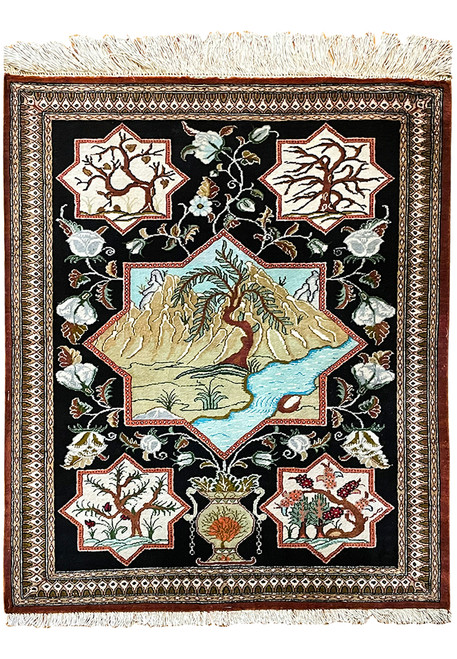

6'5" x 9'10" Persian Qum Silk Rug | Ivory Medallion on a Red Field
Silk pile on a silk foundation, knotted at approximately 800 knots per square inch, which is the level where a drawing like this one stops being decoration and becomes draftsmanship. The 6'5" x 9'10" format puts it squarely among 7x10 Persian rugs, large enough to anchor a seating group yet light and supple in the hand, as the folded corner photograph shows. The silk warp lets the weaver pack the knots tighter than any wool foundation allows, and you can see the result in the hairline outlines of every leaf and tendril. Condition is excellent throughout, with full pile, straight sides and original hand-tied fringe, and the rug ships with a certificate of authenticity recording origin, material and knot count.
Please Note About the Photographs:
Silk reads differently depending on which way the pile lies. In 2 of the angled photographs the field looks lighter and more coral, while the flat overhead view and the other angled shots show the deeper true red. That shift is the natural luster of a silk pile reflecting the studio lights, not fading, dye variation or any flaw in the weave.
Design and Motifs
The composition is a large oval field set inside ivory spandrels, a classic Qum reading of the medallion and corner format. At the center sits a round ivory medallion filled with a dense arabesque in silver grey and brown, resolving to a small rose pink 8 petal rosette at the exact middle. From that point the red field flows outward in a continuous all over vine carrying palmettes, lotus blossoms, serrated leaves and tiny star flowers, with a slender pendant cartouche above the medallion and a matching one below. The oval is bounded by a scalloped brown cloud band that gives the field a drawn edge rather than a cut one, and each of the 4 corners carries a small rust brown palmette device resting on the ivory ground. Outside that, a wide main border of floral rosettes and curling vine is framed by paired guard stripes and an outer red band of repeating lotus heads, a border system fine enough that the smallest flowerhead still reads cleanly at arm's length.
Color Palette
The field is a clear tomato red, warm rather than brown, and because the pile is silk it lifts to a bright scarlet where light rakes across it and settles into a deep brick where it does not. Against that ground the vinework is worked in ivory and cream, with leaf forms picked out in soft celadon green and petals touched with sky blue and pale rose. The main border reverses the scheme: an ivory ground shaded with silvery celadon, scattered with blue and rust flowerheads and outlined in dark brown, which cools the whole piece and keeps the red from dominating the room. The central medallion is the quietest area, ivory with grey green arabesque and a single pink rosette, so the eye lands there and then travels out. This range of blue, green and pink on red is typical of the best Persian silk rugs, where the fiber itself carries the color rather than relying on heavy saturation.
Origin and Weaving Quality
Qum lies south of Tehran and is a young weaving city by Persian standards, which is precisely why it specialized: with no centuries old village formula to defend, its workshops competed on fineness and on silk. Today Qum rugs are the benchmark for pure silk work in Persia, and the rivalry between the city's ateliers is what pushes knot counts to the level seen here. The ruler photograph against the back tells the story: roughly 800 knots per square inch, with a silk warp fine enough to let the knots sit shoulder to shoulder. That density is what holds the curved line of the arabesque without a stair step, and it is also why a rug this size stays flexible and light instead of board stiff. The pile has been clipped low to expose the drawing, the selvages are wrapped in matching red silk, and the fringe is original and even at both ends.