8'1" x 11'10" Persian Bijar Rug | Rust Red Mahi Field | Ivory Medallion
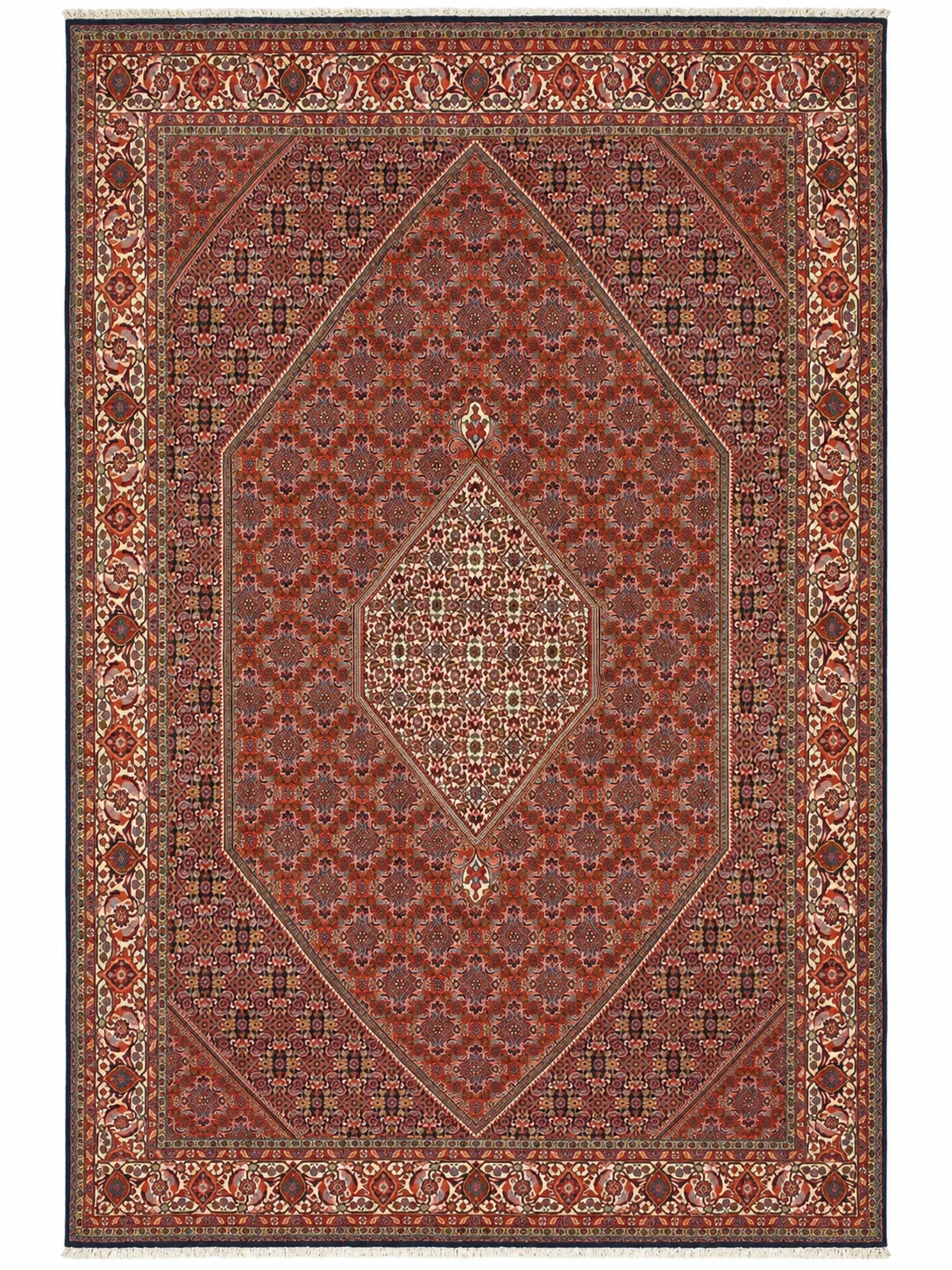
Look closely at this 8'1" x 11'10" Bijar and you will see the herati pattern worked at 2 different scales, a detail that gives the rug more movement than a standard mahi design. It is hand-knotted in wool on a cotton foundation at approximately 340 to 360 knots per square inch, fine work by Bijar standards, and it has never been used. The extra length makes it a good fit where the usual 9x12 Persian rugs are considered but the room runs long, such as a dining room with an extended table. It ships with a certificate of authenticity recording origin, materials and knot count.
Design and Motifs
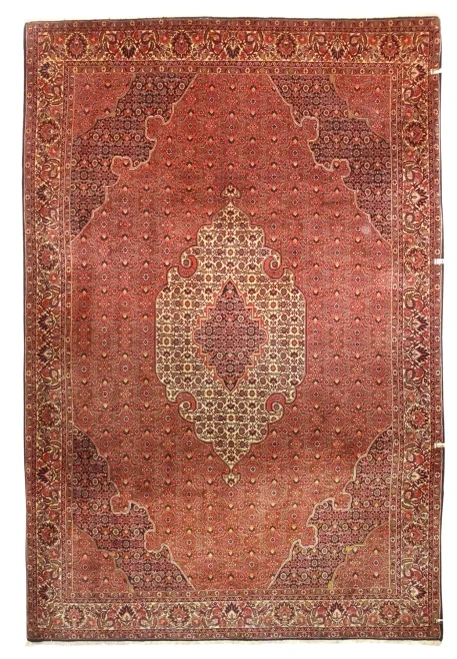
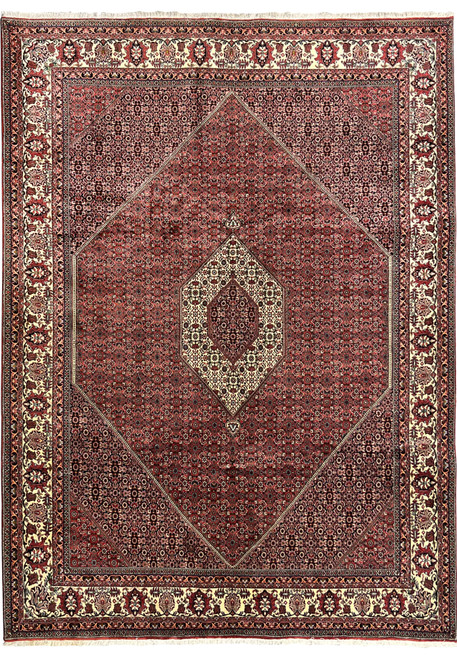
A long rust red lozenge with stepped ends runs down the center of a navy field. Inside the lozenge the herati, also called mahi or fish, is drawn large and bold, with each diamond unit clearly outlined in navy and purple. Around it, on the navy ground, the same motif is smaller and denser. At the center of the lozenge sits an ivory hexagonal medallion with the finest herati of all, and a small red finial marks each end of it. The rosette held in 4 curved leaves is the same in every zone, only the scale and color change. The main border has an ivory ground with red and navy palmettes, rosettes and curling leaves, set between narrow red guard stripes and a navy outer band.
Rust Red, Navy and Ivory
Rust red fills the lozenge, a warm tone that sits between brick and terracotta. The large herati on it is outlined in navy and purple, with small orange, rose and mint green rosettes, so the red area has a soft, patterned depth rather than a flat color. The navy field around it is darker and quieter, its smaller lattice drawn in rust, rose and ivory. The ivory medallion lifts the center with a fine lattice in red, navy and dark green. The ivory main border frames the whole rug in light, with red, navy and olive green palmettes and a few light blue accents. Because the pile is unused, the colors have their full original clarity, with no fading or wear on the high points.
A Heavy, Long-Lived Bijar
Bijar lies in the Kurdish highlands of western Persia, where the Kurdish and Afshar weavers of the Gerus region developed one of the toughest weaves in the rug world. The wool is dampened as the work progresses, and each row of wefts is driven down with a heavy metal comb until the fabric is dense and stiff. That method is the reason Persian Bijar rugs are called the iron rugs, and it also keeps the pile standing upright, so the rug feels firm and cushioned underfoot. On a cotton foundation at 340 to 360 knots per square inch, this piece adds crisp drawing to that famous strength, and since it has never been used, its whole life is still ahead of it.