
The world of Oriental rugs holds an almost unbelievably wide stylistic range, yet Chinese rugs are unique in kind and easy to tell apart at a glance. One telltale trait is their ornamental motifs, which appear on the field without any relation to one another and without sharply drawn outlines. They seem to float. The number of colors is deliberately limited, and the palette is never loud or harshly contrasting. Chinese weavers work with only 6 basic colors in varying tones, and they handle the interplay and harmony of those colors with remarkable sensitivity. Blue and yellow predominate.
The Chinese rug style also ignores a border that is otherwise nearly impossible to cross in rug design: the divide between the geometric and the floral vocabulary. Chinese rugs live on the synthesis of the two. Patterns are geometric and abstract, stylized and naturalistic all at once, and all of this lends Chinese rugs a fascination entirely their own.

The most important weaving centers of China, with typical Chinese border designs: meander frets below, floral elements above.
A Language of Symbols
What truly sets Chinese patterns apart from every other rug tradition is their eminently symbolic character. Nothing on a Chinese rug is mere decoration.
The most common layout divides the field around a central medallion, sometimes joined by 4 further medallions in the corners of the field, a scheme known as "4+1." Motifs may also be spread across the field in a set pattern, arranged more or less symmetrically. The borders serve purely as a frame for the rug and display a wide variety of motifs of their own. Peonies and other flowers dominate, alongside assorted symbols, meander frets, the ancient wan symbol of good fortune, and T-shaped fret designs.
How a Chinese Rug Is Made
Chinese rugs differ from all other Oriental rugs in their technical construction as well. They are knotted with the asymmetric knot, and the knot density is notably low, around 500 to 600 knots per square decimeter, roughly 32 to 39 KPSI. To conceal the coarse foundation weave, which as a rule consists of cotton, the pile is traditionally sheared quite high.
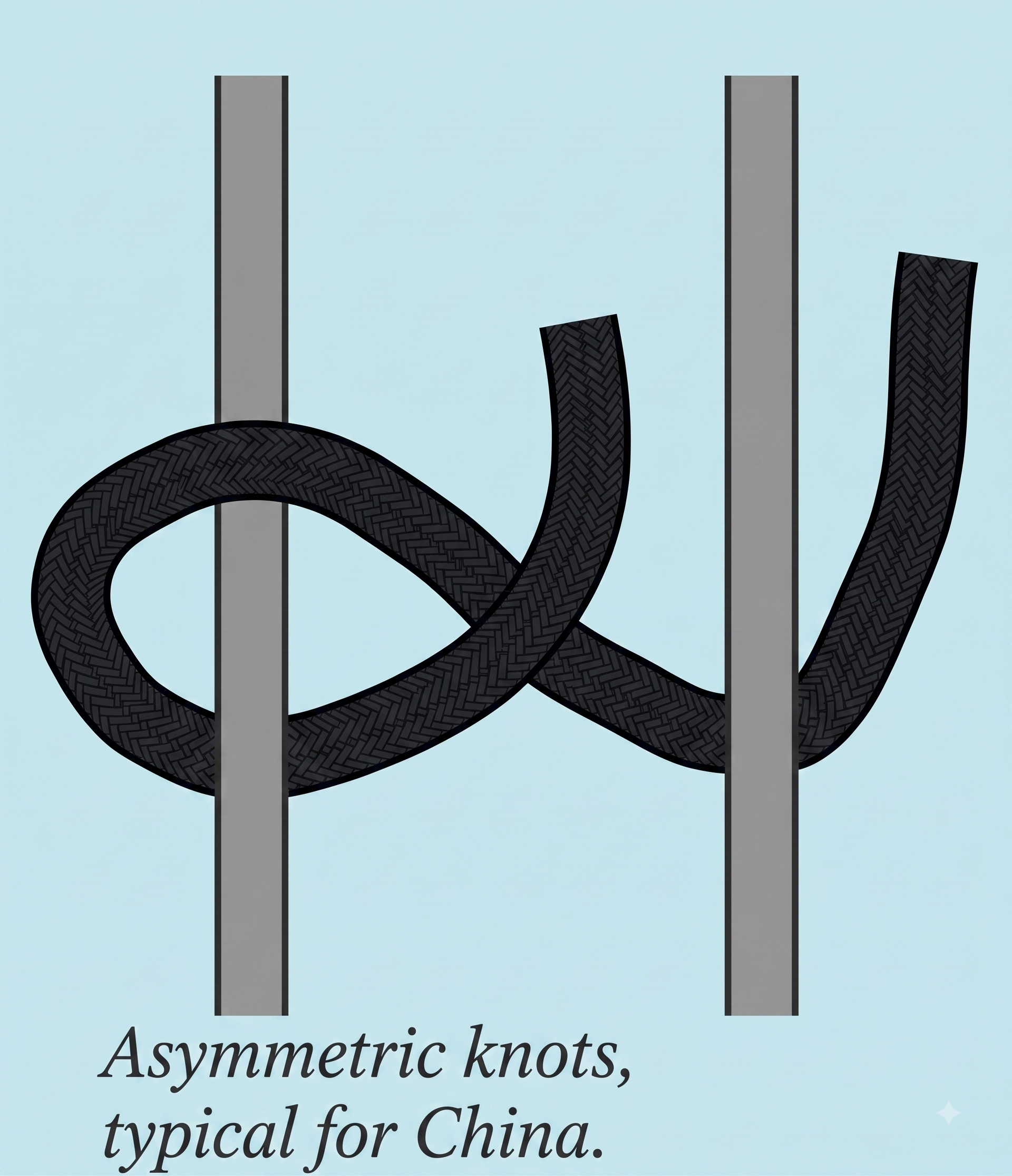
The asymmetric knot, typical for China.
From the beginning of the 20th century, a distinctive custom developed: the outlines of the figures are incised with special shears and modeled in relief. The entire pile is also sheared to different heights, with the pile of the ground field clipped deeper than the motifs. The result is the sculpted, almost 3-dimensional surface that has become a hallmark of Chinese rugs.
The formats of antique Chinese rugs tend toward an almost square proportion, on average 200 x 270 cm, roughly 6'7" x 8'10". The most recent rugs, by contrast, come in a wide variety of formats and can also grow very large, on average 300 x 400 cm, roughly 9'10" x 13'1".
The Official Art of China
The art of rug knotting had to fight particular difficulties in China. To begin with, wool was not easy to come by. And the specific character of hand knotting made it impossible to follow the otherwise universally accepted aesthetic canon, which demanded the rendering of the tiniest details and a calligraphic perfection. So it came about that the rug only entered the ranks of the great courtly artworks from the second half of the 17th century onward, extremely late compared to the other great rug knotting regions of the Orient.
This was in no way a matter of introducing a new product from abroad, as had happened in India. It was a matter of granting a higher rank to an art form that at least part of the Chinese population had already been living with for centuries. In fact, the Chinese most likely adopted the knotting technique in very early times from Central Asian peoples who had pushed into the northwestern provinces of China. It was only in these regions that the Chinese art of rug knotting developed and spread.
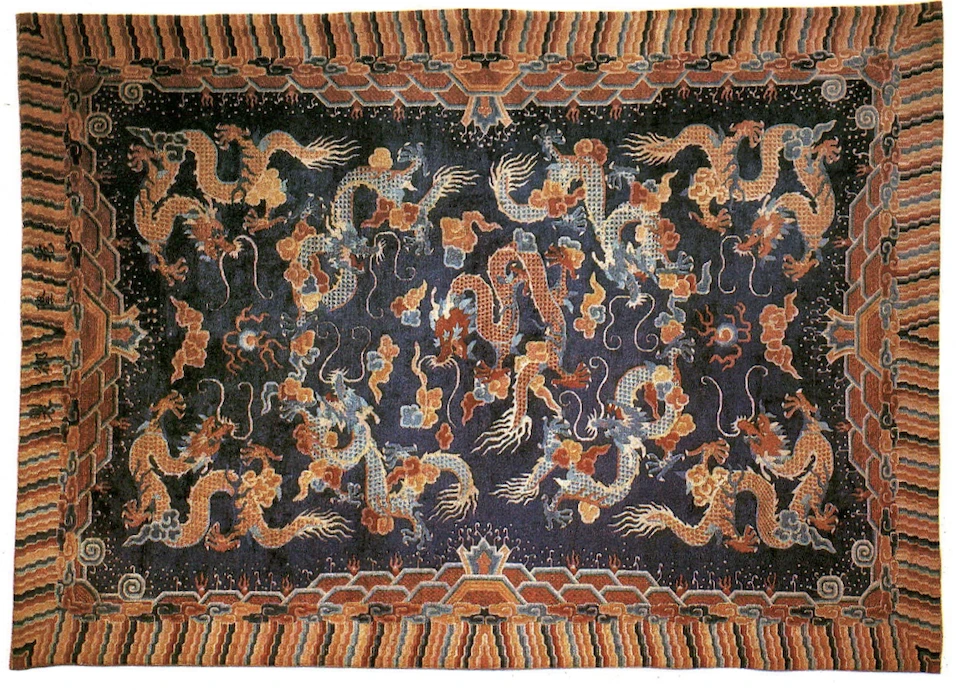
Silk rug with symbolic motifs, 18th century. Dragons dominate the field, regarded as bringers of good fortune, playing with the flaming pearl, a symbol of purity. The wave design of the border represents the sea, above which cloud heads and holy mountains rise.
Even once official culture began to take an interest in rugs after the middle of the 17th century, placing them on equal footing with porcelain and painting in artistic importance, production long remained confined to the northwestern territories and continued to be carried on by private workshops. And although the art of the rug was never taken up and refined in courtly workshops, it still made real progress, always within the framework of the universally accepted aesthetic canon and always with the wishes of the ruling class in mind.
The Chinese Rug Style
The Chinese rug style differs sharply from the Islamic one already in its general composition. The surface of the rug is not treated as an emptiness that must be filled with interconnected patterns. It serves instead simply as a background for traditional motifs, each conceived independently of the others, without ornamental connections and without any horror vacui, that fear of empty space so typical of other rug traditions.
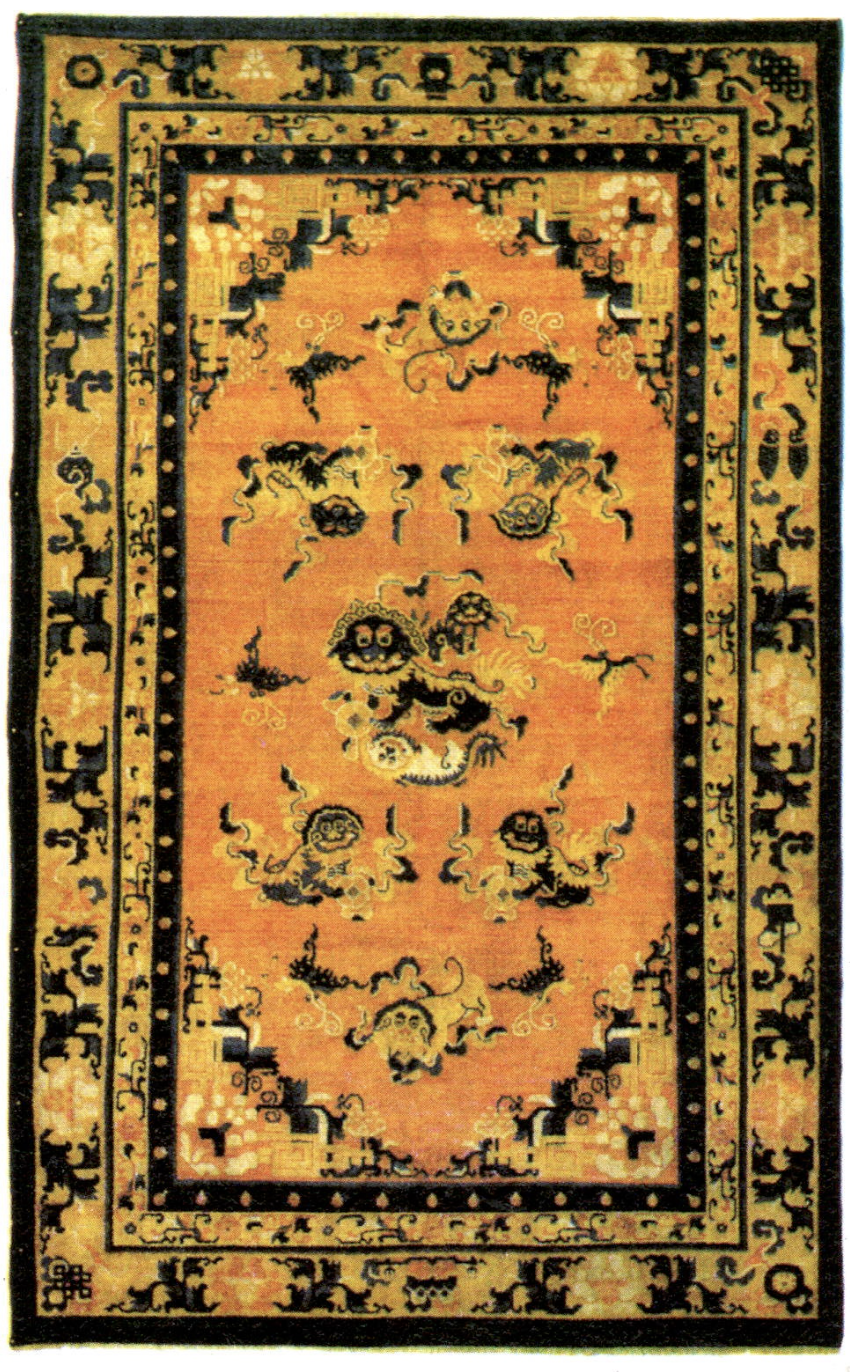
Rug with symbolic elements, end of the 19th century. In the middle of the field, as a medallion so to speak, the depiction of the Fo dog, which protects against evil, surrounded by further dogs.
In the Chinese conception, every genre of art is only a means to express certain concepts through codified motifs and symbols. And these symbols always keep their individual meaning, independent of their relationship to the other symbols around them. The middle field is therefore understood as a still, immovable space in which the various traditional motifs float in isolation. A compositional scheme for their distribution naturally exists, although with so few motifs in use it is barely recognizable to our eyes, if at all.
The Chinese formal language, which tends toward perfection in a calligraphic sense, expresses itself in the rug in both the geometric and the floral style. Both are handled with great skill, and so the result is not a confused, hybrid vocabulary but a balanced, elegant expression in which strictly geometric motifs stand beside softly curvilinear ones.
The most widespread layout calls for a central medallion with 4 further medallions in the corners of the field. The medallion, however, has no fixed form and is not completed by pendants. It consists instead of the totality of several elements, for example mythical animals, geometric blossoms, or figures. These are generally arranged into a circle, often without a single closed line that could hold the pattern together. In old rugs especially, a geometric grid, worked out in varying degrees of detail, was laid over the entire field. The pattern elements serving this grid were the ancient wan symbol of good fortune, "round brackets," or the "rice grain motif," which consists of small, slanted segments arranged regularly in 4 directions that genuinely resemble grains of rice.
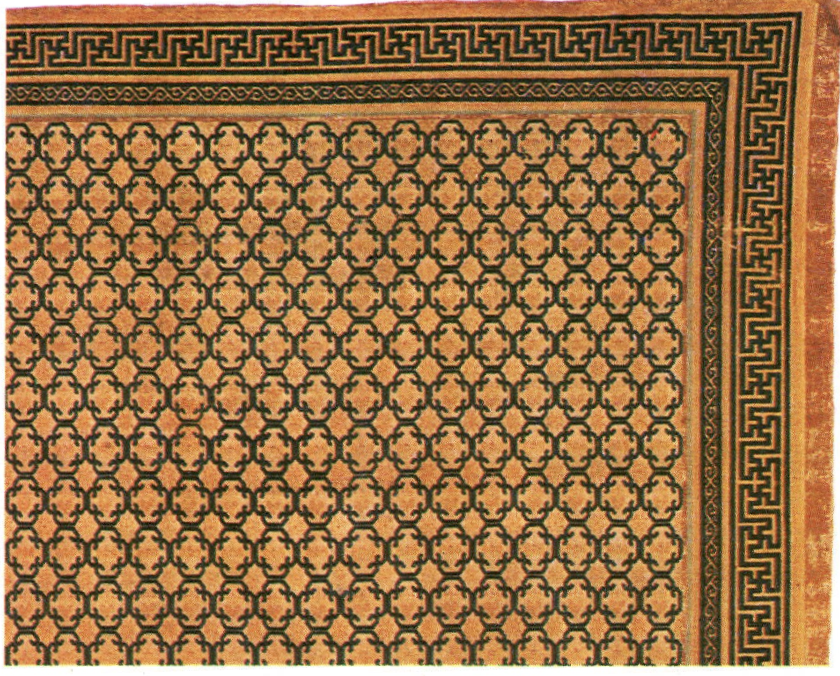
Detail from a rug with geometric patterning, 18th century. The basic form of the pattern recalls round brackets. Through the interlockings, a curvilinear image emerges.
Scattered across the entire field, naturalistic floral patterns appear as well, above all peonies and lotus blossoms. Symbolic figures are also readily strewn over the field, apparently without any fixed order.
In this connection, the pillar rugs deserve mention. They were bound around the pillars of Buddhist temples, as a substitute for paintings so to speak. Only when the 2 long edges stood side by side did a continuous pattern emerge. Dragons, for example, were depicted running around the pillar, accompanied by further significant religious or philosophical symbols.
In contrast to the Islamic conception, the border is not regarded as an important element for completing the field, but merely as a frame, one that can be filled with floral or geometric motifs, often set in a harmonious contrast to the drawn pattern of the field. Among the most frequently used patterns of the main borders are various meander frets, which often appear 3-dimensional, the wan symbol, T-shaped motifs, and naturalistic floral motifs, for example peonies or lotus blossoms.
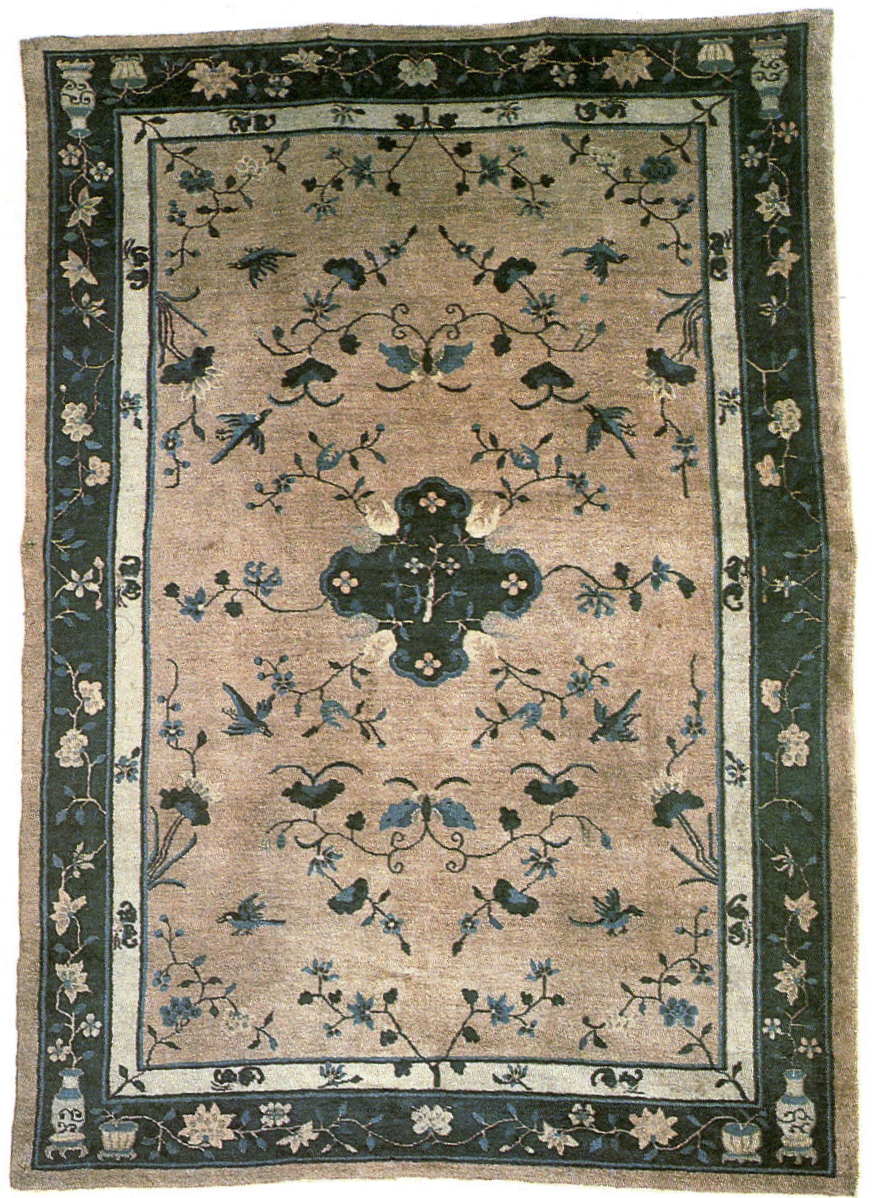
Medallion rug, end of the 19th to beginning of the 20th century. The cruciform medallion is surrounded by naturalistic motifs, for example blossoms, butterflies, and birds. Their arrangement is symmetrical. In the main border, blooming peonies and vases can be seen.
Beneath the borders, the pearl chain is a favorite, a sequence of white circles, generally set on a blue ground. Also typical for Chinese rugs is an outer edging stripe, which in the oldest rugs was dyed brown and, in the younger ones from the beginning of the 19th century onward, blue.
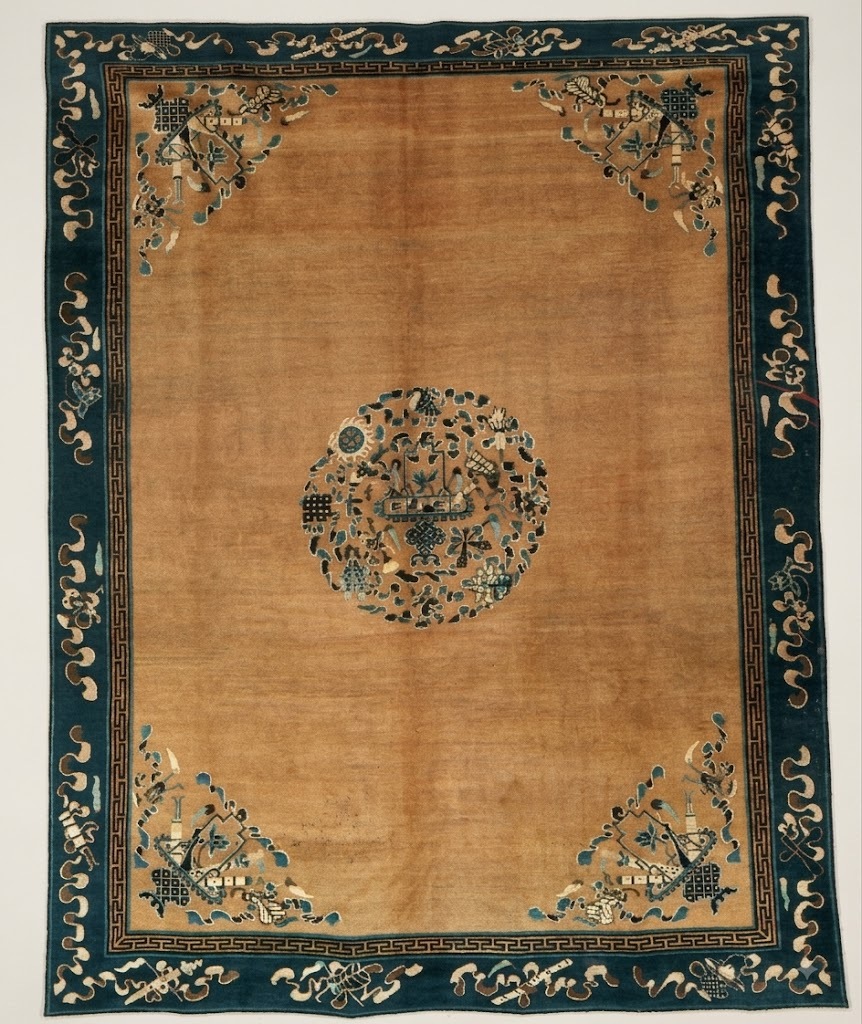
Medallion rug, end of the 19th to beginning of the 20th century. The central medallion and the medallions in the corners of the field consist of Chinese symbols. Among them we recognize, for example, the endless knot, lotus blossoms, and fish. In the main border, Taoist symbols are depicted.
In their coloring, Chinese rugs stand clearly apart from the Islamic ones, for they know neither their liveliness nor their delight in contrast. Nor is red the dominant color. Only a few basic colors were used in the Chinese rug, for example yellow, blue, white, light red, black, and brown. In exchange, the knotters drew on various tones of these colors to achieve harmonious, elegant effects, for example light yellow on a golden yellow ground, or apricot on salmon pink.
In every case, the colors yellow and blue predominate, as symbols for the earth and the heavens. In rugs knotted before the second half of the 19th century, the ground is almost exclusively yellow, while in later rugs it takes on an intense blue.
The Old Production
After the golden age between the 18th and the beginning of the 19th century, a slow decline began for the Chinese rug as well. From the years around 1860 to 1870, an alignment with Western taste becomes unmistakable. The motifs lose purity and refinement. With the introduction of synthetic dyes, pastel tones spread. The middle field appears too empty or, at the other extreme, overfilled. The borders grow larger and more complicated. For the ground, almost nothing but blue is used. The knotting itself becomes more refined, yet it loses its bond with tradition.
In the second half of the 19th century, imperial workshops such as the one of Peking replaced the small provincial workshops, joined by the quite numerous workshops run by Western entrepreneurs. The desire to expand trade led step by step to decadence and finally to the death of the traditional Chinese rug. The endpoint of this development was reached in 1920, when landscapes, human figures, and above all imitations of French floral patterns of the 17th century from the workshops of the Savonnerie and of Aubusson found their way in. Such hybrid rugs were also often sheared in relief, to make the pattern stand out more strongly against the ground.
The Chinese Symbols
The old motifs that appear on Chinese rugs have only to a small degree a purely decorative function, for their nature is in truth symbolic. The language of art in China works mostly with symbols that are shared across all genres and techniques of art, and their meaning has remained unchanged for centuries. Even so, interpretation is anything but easy. Some symbols were taken from the natural world, others descend from old myths, and still others from the Buddhist or Taoist religion. There is also a considerable number of abstract, more or less complicated patterns.
The most widespread symbols are the dragon (union of the earthly and heavenly forces, bringer of good fortune, symbol of the emperor), the phoenix (immortality, symbol of the empress), the Fo dog (protection against evil), the lotus blossom (purity and summer), the peony (esteem and wealth), deer and stork (longevity), the cloud (divine power), mountain and water (safety on a restless sea), the bat (good fortune, for its Chinese name Fu sounds phonetically like Anfu, which means good fortune), the wan symbol, in the West often called a swastika (a cosmic symbol), as well as the ideogram Shou (good fortune).
Typical for the pillar rugs are the 8 auspicious symbols of Buddhism: the canopy (kingship), the lotus blossom (well-being), the parasol (authority, good and just government), the conch horn (victory), the wheel (the path of salvation), the vase (harmony), the 2 fish (good fortune and benefit), as well as the knot of life (longevity and destiny).
Equally characteristic are the 8 Taoist symbols: the sword (victory), the gourd with the crutch (healing), the fan (immortality), the flower basket (magic), the cymbals (soothing music), the flute (miracle), the lotus flower (well-being), and finally the bamboo and the rods (foresight and good fortune).
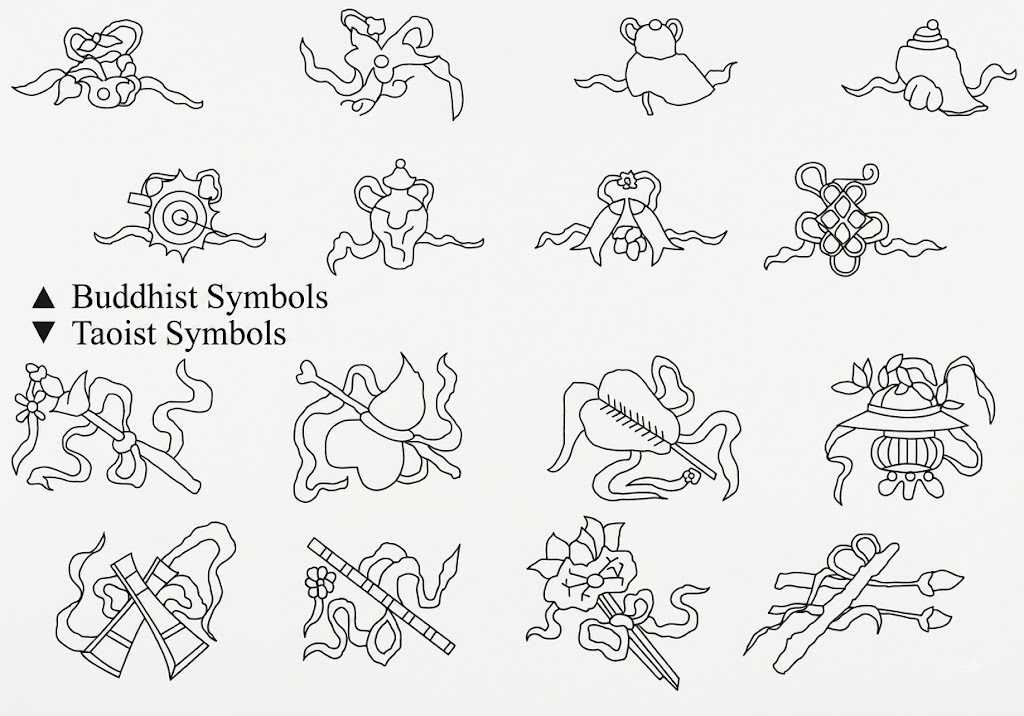
Above: Buddhist symbols. Below: Taoist symbols.
The Most Important Weaving Regions
Given the general stylistic unity of Chinese rugs, it is not easy to determine the origin of a rug from the pattern alone. Differences in color and technique, alongside stylistic features, made it possible to distinguish groups of rugs, though these can be assigned to particular knotting regions only with some uncertainty. These regions lie mainly in the northwestern provinces.
Region of Ningxia. The knotted rugs from this region are considered the classics among the Chinese, the oldest and therefore the best. Characteristic are the pure motifs, the yellow or at most pink grounds, and the predominantly blue drawing. The origin name Ningxia was, incidentally, misused so heavily that in the end almost every rug received this name. In technical terms, these rugs are set apart by their low knot density, the lowest of all Chinese production, and by their rather soft consistency. All the patterns presented so far were used here.
Region of Gansu. The rugs of this provenance show livelier colors and, as far as the patterns are concerned, stand closer to the rugs of East Turkestan. This is recognized above all in the characteristic rugs with 3 rounded octagonal medallions lying one above the other. Typical for the region is the Bulo motif, which consists of tiny red, white, and light blue disks scattered over the whole field. The ground of the field is generally blue, the drawing light red or orange.
Region of Baotou. These rugs arose at the earliest toward the end of the 19th century and are distinguished by their higher knot density and their small formats. The drawing rested at first on stylized, later on realistic patterns, for example landscapes and human figures. The ground is mostly red.
Peking. The workshop of Peking arose around 1860 and created the largest number of rugs. They are decidedly large and appear compact. The ground is normally blue, beige, or ivory and carries naturalistically depicted flowers, the most varied symbols, and central medallions that often consist of landscape elements.
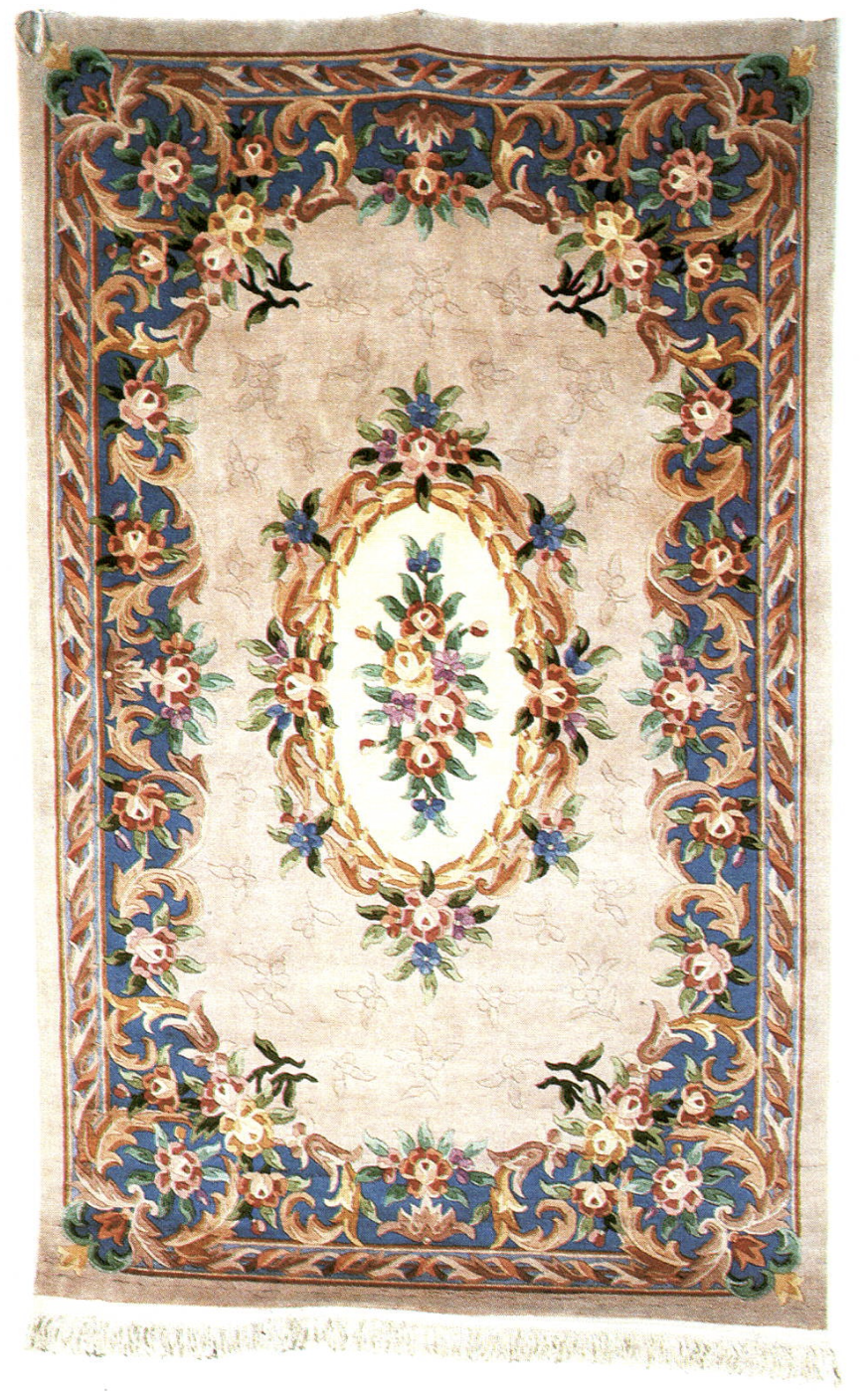
Medallion rug, modern production. The hybrid style, plain to see in this example, developed in the 1920s. The aim was to imitate French rugs of the 17th century with floral motifs. Recognizable here as well is the relief-like shearing that arose in that period.
The rugs of modern production as a rule show elements of the various provenances. To these are joined motifs of the West, and typical in this connection is the imitation of the floral elements of the French rugs of the 17th century. Just as with the Chinese rugs of past centuries, determining the geographic origin of the modern rugs is not easy either.
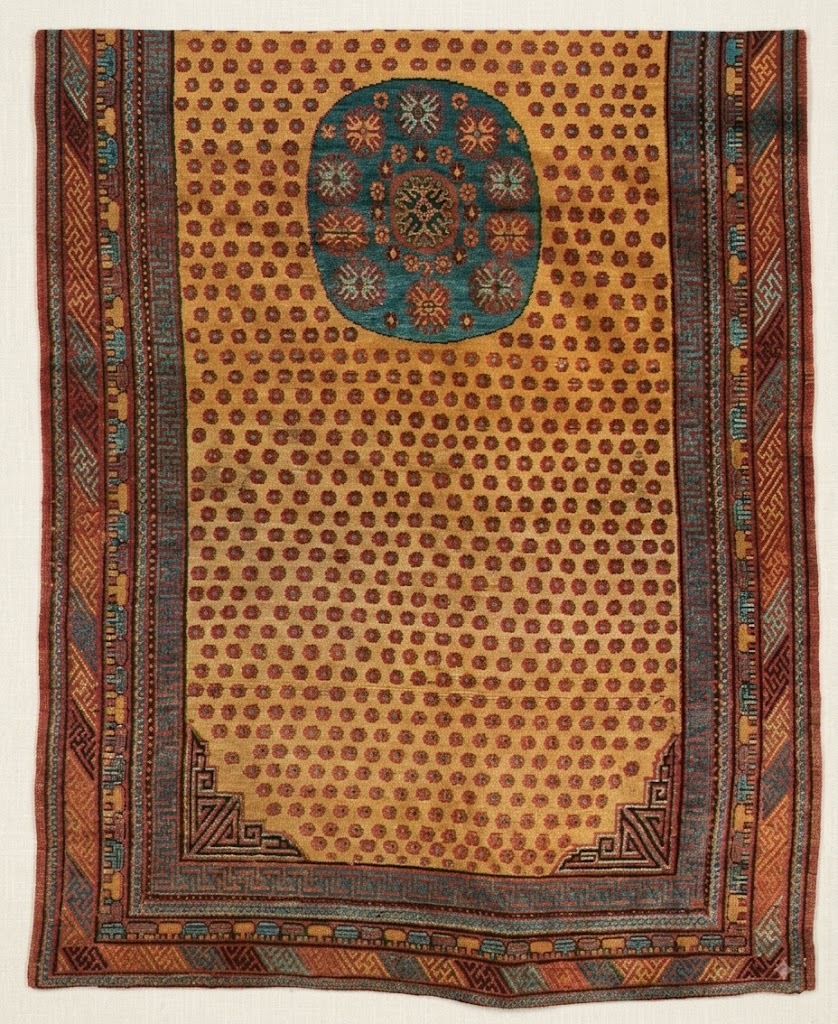
Detail from a medallion rug from Gansu, beginning of the 20th century. The rug imitates East Turkestan rugs, as the roundish medallion above all reveals. Typical for the region of Gansu, by contrast, is the Bulo motif, made up of tiny disks scattered over the whole field.
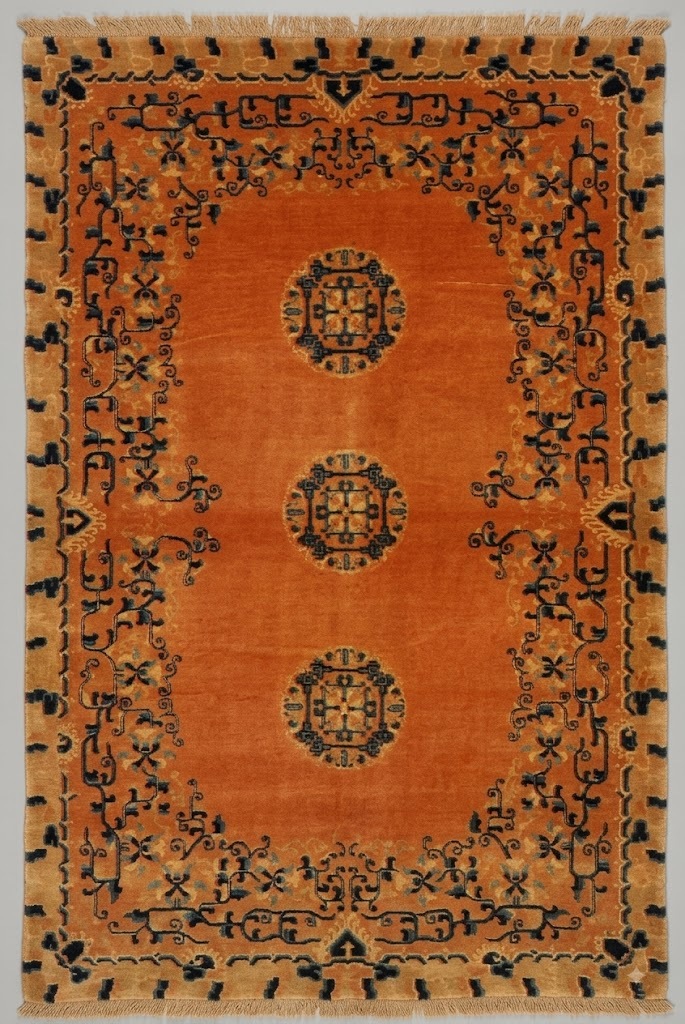
Rug with 3 medallions lying one above the other, end of the 19th century.

Rug with floral patterning, end of the 19th century. The non-traditional colors and above all the overly rich patterning of the field suggest a dating to the end of the 19th century.
From the Weaving Regions of Asia to Your Door
Our family has been in the rug trade since 1985, buying directly at the source. The same trained eye that weighs a Ningxia medallion or reads the ground of a Peking rug judges every rug we import, and every rug we sell ships with a certificate of authenticity. Chinese rugs are one chapter of a much larger story, and if you want the full picture, our complete guide to Oriental rugs carries the thread on. And if the dating questions raised by the rugs on this page caught your interest, our guide on how to date an Oriental rug goes deeper into exactly that craft.
Every order ships free to all 50 states, Puerto Rico, the US Virgin Islands, and Canada, with free returns for 31 days from the mainland US. Order by 2 PM EST on a weekday and your rug ships the same day. In our Northeast 13-state zone, our own drivers deliver in a guaranteed 24 to 48 hours and hand the rug over at your door.
And if you would rather not take our word for any of it, our customers say it better than we can, five stars on Google, every single review.
Rugs.net Headquarter
371 South Main St.
Freeport, NY 11520
Phone and text: (855) 576-7705