
Atherton is the rare American town that owns almost nothing you can see. There is no downtown, no row of storefronts, barely a sidewalk. The most expensive zip code in the country presents the street with hedges, gates, and old oaks, and keeps everything that matters on the other side. That is exactly why the rug matters more here than almost anywhere else. When a home is built to be experienced rather than displayed, the floor becomes the one surface every guest actually touches, reads, and remembers.
Wealth That Whispers
Atherton culture is built on restraint. One-acre lots, deliberate quiet, and a long local habit of never announcing anything. The people who live here run companies whose names everyone knows, yet the town itself refuses to perform. Inside the gates, that restraint turns into a very particular taste: rooms that avoid logos, avoid trend cycles, and favor things whose value can be verified rather than claimed. A hand-knotted rug fits this culture perfectly because its worth is written into its structure. Flip the corner and count the knots. The quality is a fact, not a story.
This is also a town of engineers and investors, people who instinctively ask how something is made and how long it lasts. A great rug answers both questions better than nearly any object in the house. Wool and silk tied knot by knot on a silk or cotton foundation is a technology that has not been improved in five centuries, and a well-made example will outlive the house it sits in.
Two Athertons, One Floor Problem
Architecturally, Atherton is really two towns living behind the same hedges. The first is classic: brick Georgians, shingled traditionals, and Mediterranean estates in Lindenwood and West Atherton, homes with formal dining rooms, libraries, and proportions that ask for depth of color and pattern. The second is new: modern farmhouses and glass-and-timber contemporaries replacing older homes lot by lot, with pale oak floors, white walls, and rooms flooded with soft peninsula light. Both need handmade rugs, but they need very different ones, and the mistake we see most often is putting the wrong Atherton's rug in the wrong Atherton's house.
Below we have pulled rugs from our Freeport gallery for each of those houses. Every one is 100% hand-knotted, every one ships free to Atherton, and every one can be returned free within 31 days if it does not sit right in your rooms. Trying a rug at home costs you nothing but the time to unroll it.
For the New Atherton: Light, Low, Open
The contemporary Atherton house has a scale problem and a color problem at once. Great rooms here routinely run past twenty feet, so standard rug sizes float like postage stamps, and the pale, quiet palettes of modern construction are easily overpowered by a traditional red field. The answer is oversize handmade rugs in washed, muted tones: ivory, grey, slate blue, sage. These read almost like texture from across the room, then reveal centuries-old drawing the moment you look down.
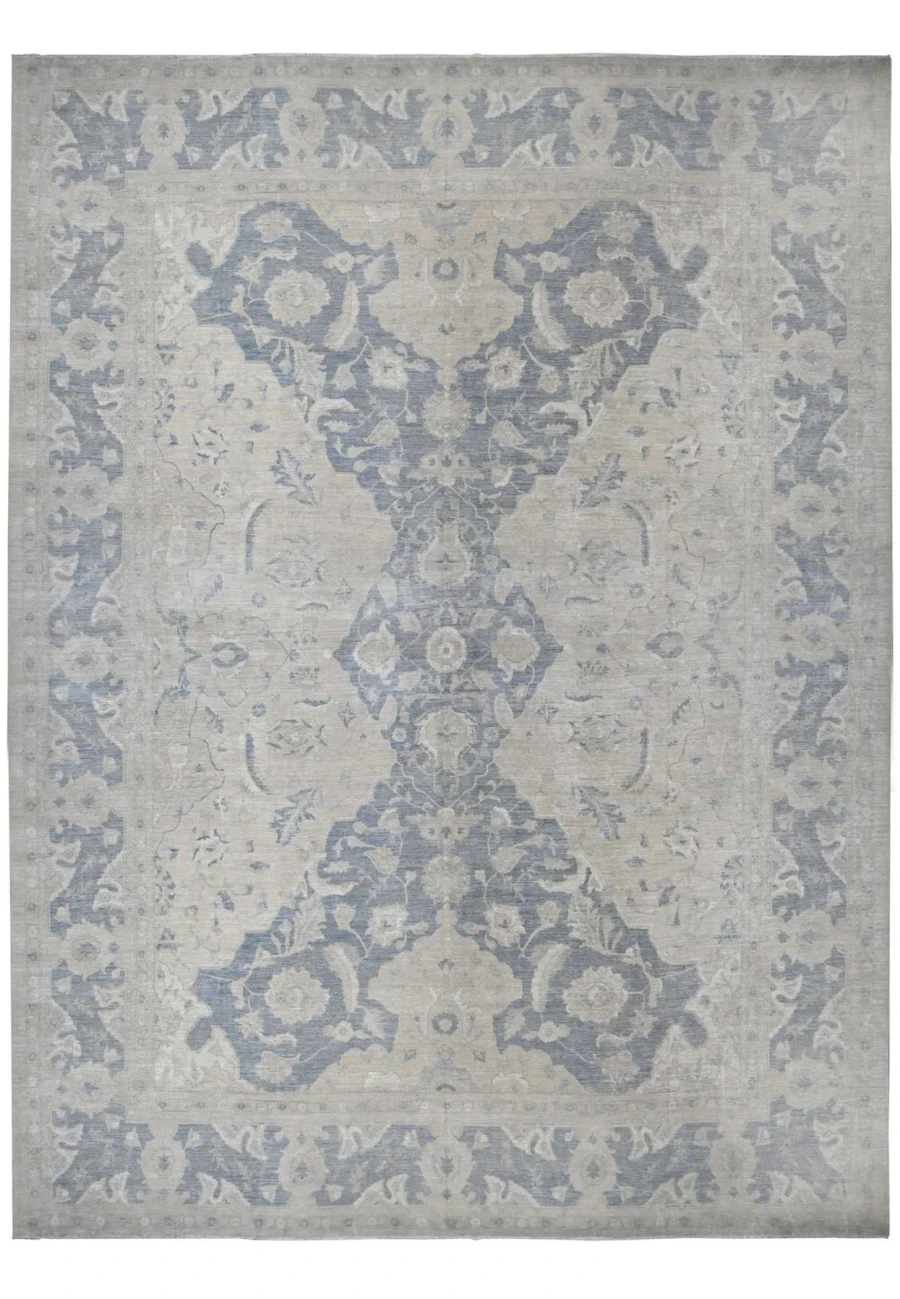
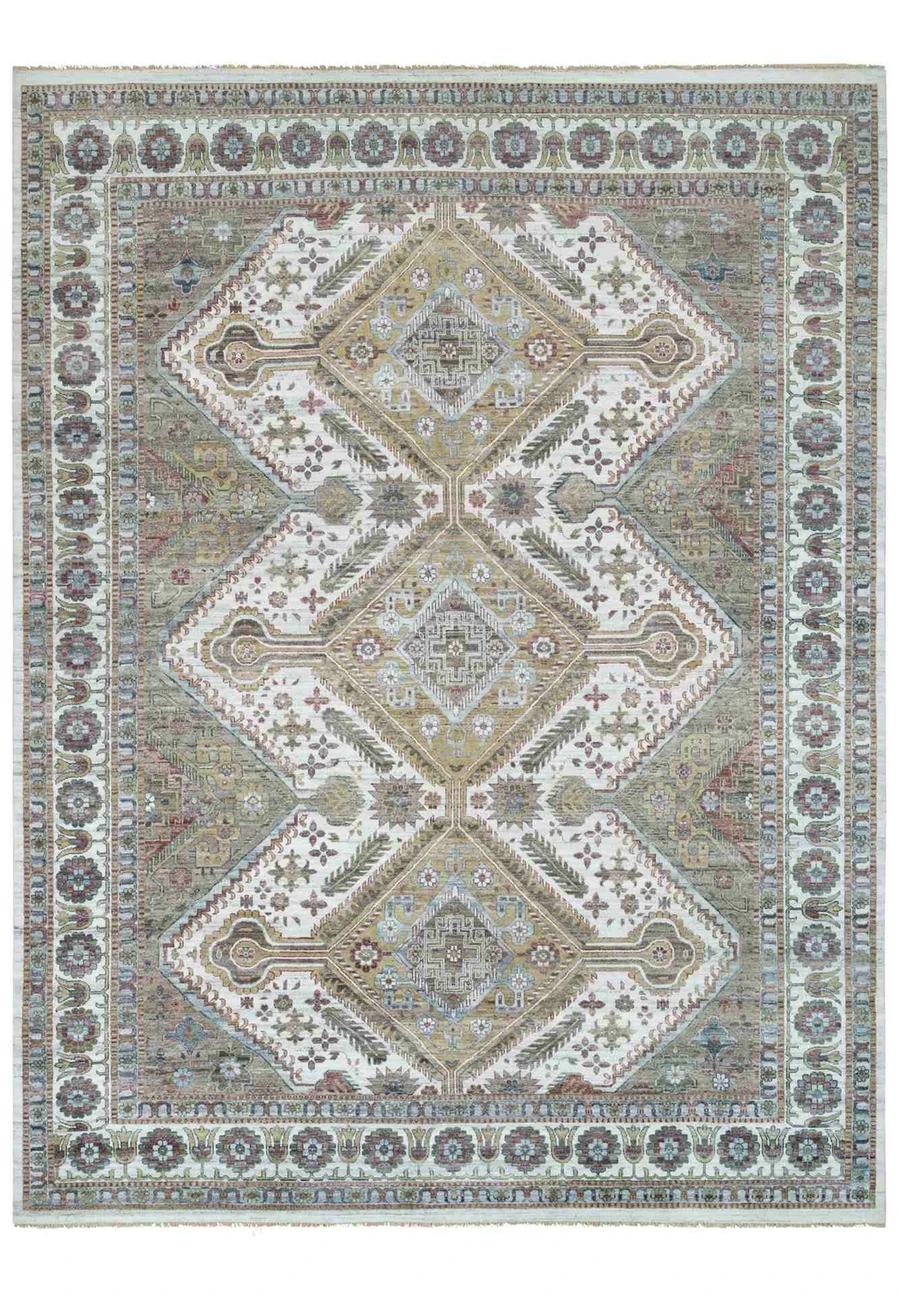


The paper-white Peshawar deserves a special word for Atherton. Its drawing descends from the Polonaise carpets woven for European courts in the 1600s, yet the washed slate-and-ivory coloring reads as completely contemporary. At over 18 by 24 feet it is one of the few rugs anywhere that can hold a full Atherton great room on its own. The sage green Isfahan plays the opposite role: a small, extraordinarily fine rug for the study or primary suite, in a field color almost never seen from this weaving city. And if the quiet precision of the Habibian appeals, our guide to Nain 6La and Habibian rugs explains what makes these the finest expression of the craft, and our full Nain collection holds more sizes.
For the Classic Estate: Depth and Provenance
The established Atherton estate asks for something else entirely: rugs with age, density, and a story that holds up to scrutiny. A formal dining room under old oaks wants saturated color and drawing fine enough to reward the long dinners this town is actually known for. These four bring museum-grade weaving and, in one case, more than a century of documented age.


The antique Bakshaish is the kind of rug that grounds brand-new construction with a century of honest wear, and at 12'6" by 19'6" it fits the long formal rooms of the older estates as if it were commissioned for them. The Tabriz 70 Raj sits at the opposite pole: 660 to 680 knots per square inch on a pure silk foundation, weaving so fine that from standing height it reads almost like a painting. The Kerman brings the rarest border in the group, a full pictorial garden of willows and birds circling the field. Both weaving cities are represented in depth in our Tabriz collection and Kerman collection.
The Atherton Standard
In a town where nothing is bought to impress the street, an object earns its place by being verifiably excellent. A hand-knotted rug is one of the few things in a home whose quality you can prove yourself: turn the corner, look at the back, and count.
How to Judge a Rug Like an Engineer
Atherton buyers tend to ask better questions than most, so here are the answers up front. Knot density (KPSI) is the resolution of the drawing: the Nain above runs 550 to 600 knots per square inch, the Tabriz 70 Raj up to 680. The foundation is the frame the rug is built on: silk foundations allow the finest work, cotton foundations give sturdy everyday performance. And the pile material determines how the rug ages: wool wears in rather than out, while silk highlights catch the light and shift as you move through the room. If you want to go deeper, our guide to rug foundations and our complete Isfahan guide explain exactly what separates the great from the good.
Buying From Rugs.net in Atherton
✓ Free shipping to Atherton and all 50 states
✓ Free returns for 31 days with free home pickup
✓ Same-day dispatch on weekday orders before 2 PM EST
✓ White glove delivery by appointment, placed in your room
✓ Immediate refunds, not store credit
✓ Price beat guarantee: find it lower, we beat it by 10%
Delivered Behind the Hedge
Our family has been in the handmade rug trade since Hamburg in 1985, and today we source directly from the world's finest rug-producing regions and ship from our gallery in Freeport, New York. Because we import directly, there is no showroom markup between you and the rug, which is how a 660-knot Tabriz or a circa-1900 palace-size antique arrives in Atherton at a fraction of the West Coast gallery price for the same quality.
And because privacy matters here, so does the delivery. White glove service comes by appointment: the rug arrives when you say, is unrolled and placed in the room you choose, and if it is not right, we pick it up from your home for free within 31 days. You never carry anything, and you never commit to anything you have not lived with.