
| Exact Size in ft: | Width: 9'2" x Length: 12'9" |
| Size in Inch: | Width: 110" x Length: 153" |
| Size in meters: | Length: 3.89m x Width: 2.79m |
| Some of many colors: | Navy Blue, Persian Red, Ivory, Salmon, Rose, Gold, Celadon, Brown |
| Shape: | Rectangular |
| Woven: | 100% Hand-knotted | Handmade |
| Foundation: | 100% Cotton |
| Pile: | 100% Wool |
| KPSI: | 220 - 240 |
| Origin: | Persian Mahal | Made in Persia |
| Condition: | Excellent | Never Used |
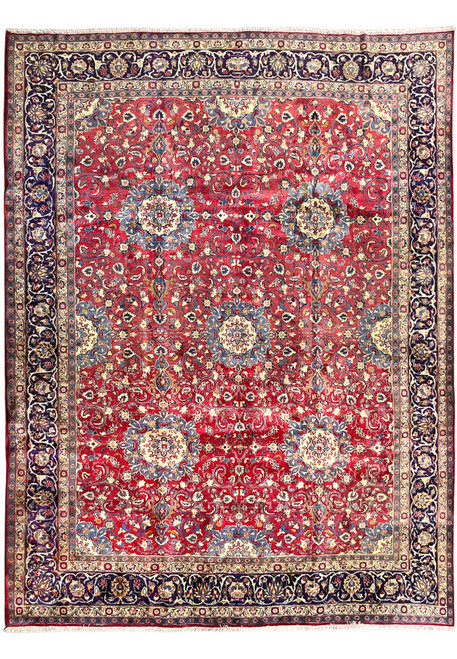
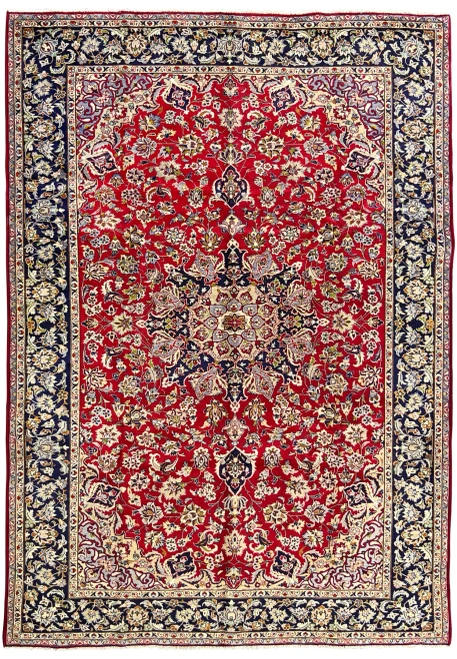
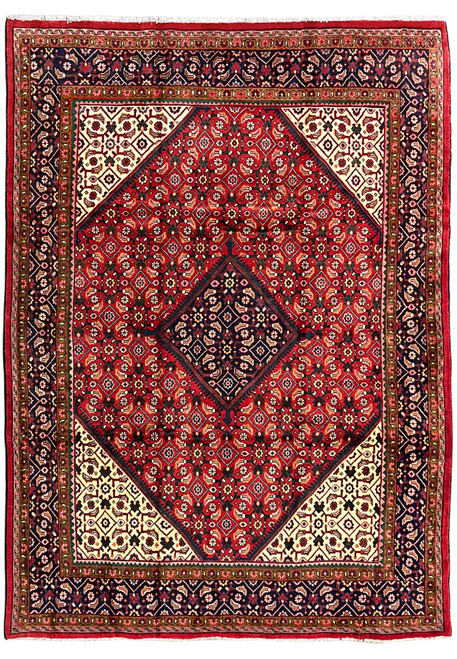
9x13 Persian Mahal Rug with Allover Herati Pattern | Navy Field | Red Floral Border
This 9'2" x 12'9" Persian Mahal is a classic example of the western Persian weaving tradition that gave Mahal rugs their reputation among American collectors and decorators for more than a century. The composition is a true allover Herati field on deep midnight navy, framed by a generous Persian red main border carrying floral cartouches and rosettes, and bookended by ivory and navy guard stripes. The rug is hand-knotted in 100% wool on a cotton foundation at approximately 220 to 240 knots per square inch, and is in excellent, brand new, never used condition. For broader context on this weaving tradition, see the world of Persian rugs.
Design and Motifs
The field is woven in the classical Herati pattern, also called the Mahi or fish design, one of the oldest and most enduring motifs in Persian weaving. The pattern is built from a small repeating unit of a central rosette inside a diamond, flanked by four curved lancet-shaped leaves that traditional weavers liken to fish circling a flower in a pool. Across the navy ground the motif repeats in tight register, with the rosettes drawn alternately in ivory, salmon, gold, and rose. The main border carries a sequence of large floral cartouches in red with ivory and navy inner medallions, separated by smaller rosettes and connected by a delicate vine. Inner and outer guard stripes carry a continuous floral ribbon on ivory, with a final small reciprocal trefoil minor border. The drawing is tight from corner to corner with strong symmetry, the hallmark of a fine workshop Mahal rather than a coarser village version of the same design.
Colors and Placement
The dominant tones are a deep midnight navy field and a saturated Persian red border, lifted by ivory guard stripes and a polychrome supporting palette of salmon, rose, gold, soft celadon, and dark brown. This is the most universally requested Mahal color combination, because navy and red sit beautifully against both light hardwood and dark walnut floors, and the allover pattern reads as quietly elegant from a distance and becomes intricate up close. At 9'2" x 12'9" this rug suits a formal living room with a sofa and two flanking chairs all on the rug, a dining room with a six to eight seat table where every chair stays on the rug when pulled out, a master bedroom with a king bed and full nightstand coverage, or a paneled library or office. The Herati allover is the safest possible choice for high-traffic and high-spill rooms because no single area of the field draws the eye, so wear and the inevitable life of a working rug never accumulate on a focal medallion.
Origin and Construction
Mahal rugs come from the Sultanabad weaving region of western Persia, centered on the city of Arak, an area that became the most important commercial weaving center in Persia during the late nineteenth and early twentieth centuries when European and American firms commissioned thousands of large-format rugs for the export market. The lustrous, slightly larger-staple wool of the Sultanabad region, combined with stable natural and chrome-stable dyes and a robust knotting structure, gave Mahal rugs the practical longevity and the relaxed, livable beauty that made them favorites of American interior designers from the 1920s through today. This piece is hand-knotted in 100% wool on a cotton foundation at approximately 220 to 240 KPSI, with the asymmetric Persian knot. The rug is in excellent, brand new, never used condition, with intact selvages, clean fringes, and the saturated original colors of pristine wool. For more on the wool, silk, and dye materials that define the construction quality of any Persian rug, see our complete guide to handmade rug materials.